
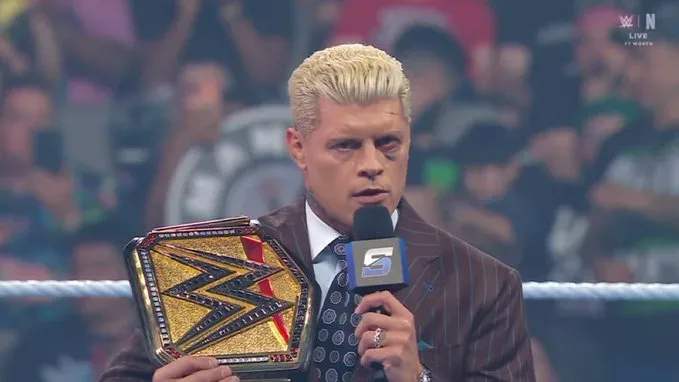
Cody Rhodes expected WrestleMania 42 to be the finish line for a while. Instead, the Undisputed WWE Champion says he was back at work the very next night, even as the physical aftermath of Randy Orton’s attack remained visible.
Speaking with Carmelo Anthony and Kazeem Famuyide on 7 PM in Brooklyn, Rhodes revealed that he believed WWE had planned to give him an extended period away from television following WrestleMania. Rhodes said he was not simply anticipating a brief reset after the event; in his mind, he was preparing for roughly three months off.
“If you tell me to put a hand up. I’m not putting a hand up. It’s WrestleMania. I thought I was getting some time off. Put me away. I thought I was getting time off. I was on the show the next night with Punk looking at me. I was getting a good three months. Didn’t happen.”
The comments add another layer to the immediate fallout from WrestleMania 42. Rhodes left the event as Undisputed WWE Champion, but his celebration did not provide the clean, triumphant conclusion normally associated with a WrestleMania title victory. Orton attacked Rhodes after the match, kicking him in the head and striking him with the championship. In the days that followed, Rhodes appeared with a noticeably swollen eye and acknowledged that the injury had affected both his vision and his ability to work.
For more background on this topic, read The Kaspers Deny WWE Backstage Heat Amid Revisit of Their Stop-Start Main-Roster Run.
Yet rather than disappearing from WWE programming to recover, Rhodes says he was placed on the post-WrestleMania show alongside CM Punk. The champion’s reference to Punk “looking at me” underscores the speed with which WWE moved into its next major television direction after WrestleMania, even with Rhodes visibly carrying the effects of Orton’s assault.
Rhodes Was Ready to Take a Break
Rhodes’ remarks frame the situation as a change from what he understood the post-WrestleMania plan to be. He did not say why the anticipated three-month absence failed to materialize, and he did not identify whether the decision changed because of a creative need, a medical assessment, a shifting schedule, or another factor. What he did make clear is that he expected to be written out after the event and was surprised to find himself working immediately.
That expectation makes sense in the context of the physical toll that a WrestleMania main-event-level schedule can carry. WrestleMania season typically requires WWE’s top stars to handle extensive television appearances, premium live event matches, promotional obligations, and media commitments. Rhodes has remained one of the company’s most central performers through that level of demand, making the prospect of a significant post-WrestleMania break understandable.
His own wording also reflects the mentality of a wrestler reluctant to show vulnerability in the biggest possible setting. “If you tell me to put a hand up,” Rhodes said, “I’m not putting a hand up. It’s WrestleMania.” The line suggests that, regardless of how he felt physically, he was determined to make it through the show rather than remove himself from its plans.
That determination came with a visible cost. Rhodes’ swollen eye was not merely a cosmetic detail in the days after WrestleMania 42. He said it affected his sight and his work. WWE has not publicly detailed a timetable for any absence tied to the injury, and Rhodes did not use the interview to offer a medical diagnosis. As a result, the precise nature or severity of the issue should not be overstated. Still, Rhodes’ description establishes that he was working through a condition serious enough to alter his vision.
Randy Orton’s Attack Changed the Tone
Rhodes may have retained the Undisputed WWE Championship at WrestleMania 42, but Orton ensured the titleholder did not leave without being marked by their rivalry. A kick to the head followed by a championship shot created a stark visual and gave the story a much different texture than a straightforward title-defense celebration.
The attack was especially significant because the championship itself was used as a weapon. In WWE storytelling, that is more than a violent post-match punctuation mark. It turns the symbol of Rhodes’ success into part of Orton’s message: the champion may still possess the title, but his hold on it is under direct threat.
Rhodes continuing to appear after that assault keeps the confrontation active rather than allowing it to cool down during an extended absence. At the same time, it creates an interesting contrast in their respective statuses after WrestleMania. Rhodes said he remained on the job despite expecting time away, while Orton took time off. The difference is notable because Orton was the man who physically left Rhodes battered, yet Rhodes was the one who immediately had to continue carrying the championship presence on television.
There is no indication in Rhodes’ comments that Orton’s time away was connected to Rhodes’ planned break or that the two situations were directly related. They simply form part of the unusual post-WrestleMania picture Rhodes described: the champion expected to be gone, the challenger attacked him, and the champion was instead back on the next show.
CM Punk Enters the Immediate Picture
Rhodes specifically mentioning his appearance with CM Punk provides an important clue about where WWE’s attention shifted after WrestleMania 42. He did not reveal the full creative context of that segment in the interview, but the reference demonstrates that Punk was part of Rhodes’ immediate on-screen environment after the event.
For Rhodes, that meant there was no gradual return or lengthy recovery period built into his schedule. The WrestleMania outcome and Orton’s attack were followed immediately by an appearance with another of WWE’s most prominent names. That is the kind of transition that can keep a champion central to weekly programming, but it also means less room to step away after a demanding season.
The timing matters because post-WrestleMania television often establishes the next phase of the title picture. Rhodes being present alongside Punk while still visibly affected by the Orton attack positioned him at the intersection of multiple major stories. His comments do not confirm a specific match, feud, or title program involving Punk, so any broader conclusion would be premature. But Rhodes’ return confirmed that WWE was not treating him as a performer headed for a prolonged hiatus.
A Champion Still Carrying the Load
Rhodes’ account is a reminder that the public result of WrestleMania does not always tell the complete story of what follows behind the scenes or on the schedule. On paper, he exited WrestleMania 42 as the Undisputed WWE Champion. In reality, he says he did so while expecting a three-month break, dealing with an eye injury that affected his vision, and then learning he would be needed on television right away.
It also speaks to the responsibility attached to being champion. Rhodes did not present himself as someone who wanted to avoid WrestleMania or retreat from its demands. Quite the opposite: he indicated that he would not have raised his hand to sit out the event. His frustration or surprise was directed at the lack of the expected recovery window afterward.
Whether Rhodes eventually receives the time away he believed was coming remains unclear. He gave no new timetable, and there is no confirmation that WWE currently intends to write him off television. For now, the available picture is straightforward: Rhodes expected a substantial break following WrestleMania 42, but WWE kept the Undisputed WWE Champion active immediately after the event.
That decision has left Rhodes moving forward with a championship, the lingering effects of Orton’s attack, and a rapidly developing post-WrestleMania landscape around him. The champion may have expected to be put away for three months. Instead, as he put it, that plan simply “didn’t happen.”

Darryl Polo
Darryl Polo is a passionate wrestling fan covering WWE, AEW, TNA and beyond. He loves great rivalries, breakout stars and the moments that keep fans talking long after the bell. How we work.