
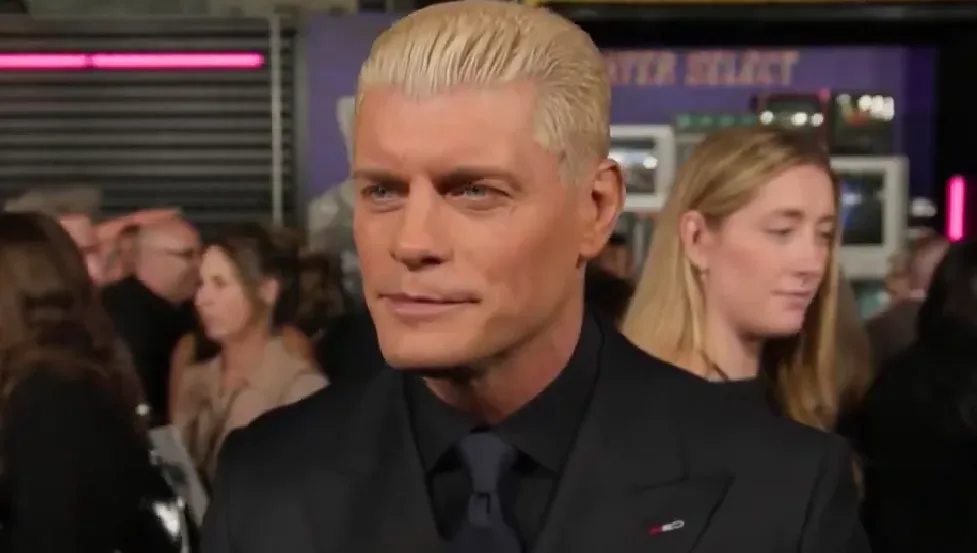
Cody Rhodes does not view his move into film as an exit strategy from professional wrestling. Instead, the WWE star sees acting as another discipline he wants to develop alongside the career that has defined his life.
Rhodes recently appeared as Guile in the Street Fighter movie, taking on one of the best-known characters from the long-running video game franchise. The project placed him in a major Hollywood production while he remained an active WWE performer, and it has naturally raised questions about whether more acting work could follow.
Speaking on The Rich Eisen Show, Rhodes made clear that he has enjoyed the experience and wants to keep building on it. At the same time, he stressed that wrestling is not something he is looking to leave behind.
“Hard have the bug, but also I think it’s probably important to say wrestling is my whole life that you said day job. It is the day job. I don’t think it would ever not be.”
For more background on this topic, read Tiffany Stratton’s Status Remains Unclear After Scary Money in the Bank Landing.
That distinction is significant for Rhodes at this stage of his career. Acting may offer a new creative challenge and a chance to expand his profile beyond WWE programming, but he continues to define wrestling as his foundation. Rather than treating the two industries as competing destinations, he is approaching them as careers that can coexist.
Rhodes Wants Reps In Front Of The Camera
Rhodes said his intention is to continue pursuing both acting and wrestling, provided the plan comes together. His comments were not framed as a guarantee that every opportunity will work out, but they reflected a clear desire to keep learning on film sets and improve as a performer outside the ring.
“It’s my plan. Hopefully it goes according to plan. It’s one of those things where if I don’t flex that muscle, if I don’t get reps at it, I’m not going to get any good at this whole thing.”
For Rhodes, the language of repetition is especially fitting. Professional wrestlers develop through constant performance: live crowds, television matches, promos, travel, timing, and the ability to react in the moment. Acting involves different demands, but Rhodes’ emphasis on getting “reps” shows that he is not viewing a single role as enough to establish himself in that field.
He also identified the kinds of projects in which he believes he can contribute most naturally. Rhodes noted that action is particularly enjoyable for him, while comedy is another area where he feels comfortable.
“Action, that’s a ton of fun, and comedy, that’s an easy place for me to plug into.”
Those genres make sense for an established WWE personality. Action projects can benefit from the physicality, body control, camera awareness, and larger-than-life presence that wrestlers bring with them. Comedy, meanwhile, can draw on the timing and character work required of performers who regularly speak live before arenas and television audiences.
That does not mean success in wrestling automatically becomes success in movies. The mediums require different skills, and Rhodes acknowledged the need to continue working at acting if he wants to improve. Still, modern wrestling stars have increasingly been given the chance to prove that their experience can translate when the right role and project emerge.
A Different Era For WWE Stars In Hollywood
Rhodes pointed to several names who have helped create that opening. Dave Bautista, John Cena, and Dwayne “The Rock” Johnson have all established high-profile Hollywood careers after becoming major attractions in wrestling. Their individual paths have been different, but collectively they have changed how casting rooms can view talent coming from the industry.
“But because of Dave Bautista, John Cena, of course, and The Rock, they’ve made it so that we can walk into a lot of these rooms and they know we have something to offer. So I’d like to keep doing that.”
The Rock became one of entertainment’s biggest crossover stars and helped demonstrate the scale a wrestler could reach in mainstream film. Cena has paired his action credentials with prominent comedic work and has continued to maintain a connection with WWE. Bautista has earned praise across action, science-fiction, drama, and ensemble projects, building a body of work that has helped challenge older assumptions about wrestlers being limited to a narrow type of role.
Rhodes’ point is not that the road has become easy. It is that the success of those performers has given the next generation more credibility from the beginning. A wrestler entering a casting conversation is no longer automatically regarded as a novelty appearance or a stunt casting decision. There is now a demonstrated track record of wrestlers bringing physical commitment, charisma, professionalism, and range to film productions.
Rhodes also believes the industry has evolved beyond the old idea that a wrestler must make a permanent choice between a ring career and an acting career.
“It’s definitely going to work in a sense of with wrestling. It’s not like it used to be where you can only pick one or the other.”
That is perhaps the central point of Rhodes’ outlook. In previous eras, a major move into Hollywood could often be interpreted as a sign that a wrestler was reducing their schedule or preparing to walk away. Today, there are more examples of performers working across both spaces, whether through carefully planned productions, shorter filming commitments, special appearances, or schedules built around major wrestling events.
Street Fighter Featured WWE’s Top Stars
Street Fighter offered a particularly notable setting for Rhodes’ acting work because he was not the only major WWE name involved. Roman Reigns also worked on the movie alongside Rhodes. Reigns is the current World Heavyweight Champion, making the production an example of WWE’s leading talent participating in a major film project while remaining connected to the company’s core television landscape.
The shared involvement of Rhodes and Reigns underlines the changing balance Rhodes described. Both performers hold enormous visibility in WWE, yet they have been able to take part in a movie based on a globally recognizable game property. Their presence in the same production also gives wrestling fans another reason to follow the project beyond its established gaming audience.
Rhodes’ role as Guile carries added interest because the character is among the most recognizable in the Street Fighter universe. Guile’s military background, signature look, and status as a franchise staple place considerable attention on any actor chosen to portray him. Rhodes entered the role with the kind of visual presence and performance background that naturally aligns with a heightened action property, but he has made it clear that he wants the work itself to be taken seriously.
His comments about needing more experience suggest that Street Fighter is not being treated simply as a one-time crossover. If opportunities emerge, Rhodes wants to continue developing in action and comedy while staying active in WWE.
WWE Helped Make The Production Possible
Rhodes also discussed the practical side of making the movie while continuing his wrestling responsibilities. Elsewhere in the interview, he explained that WWE President Nick Khan and Chief Content Officer Paul “Triple H” Levesque made the process of filming Street Fighter very easy for him.
That cooperation matters in a business where television commitments, premium live events, promotional obligations, travel, and live appearances can make outside projects difficult to schedule. Rhodes did not present the production as something that required him to separate himself from WWE. Instead, he described a situation in which the company helped make the opportunity workable.
The willingness to accommodate projects such as Street Fighter can provide benefits on both sides. Talent can broaden their skills and reach new audiences, while WWE gains additional mainstream visibility when its stars appear in prominent entertainment projects. The arrangement also supports the idea that modern WWE careers need not be confined solely to weekly wrestling programming.
For Rhodes personally, the priority remains unmistakable. He has caught the acting bug, wants to continue sharpening that skill, and sees real potential in action and comedy. But the work he calls his “day job” remains professional wrestling.
That balance will be worth watching as Rhodes moves forward. His debut as Guile has given him a major entry point into feature-film acting, and the examples set by The Rock, Cena, and Bautista show that wrestlers can build legitimate screen careers. Rhodes, however, is not describing a departure from WWE. He is describing an expansion: one that keeps him in the ring while giving him room to grow in Hollywood.

Darryl Polo
Darryl Polo is a passionate wrestling fan covering WWE, AEW, TNA and beyond. He loves great rivalries, breakout stars and the moments that keep fans talking long after the bell. How we work.