
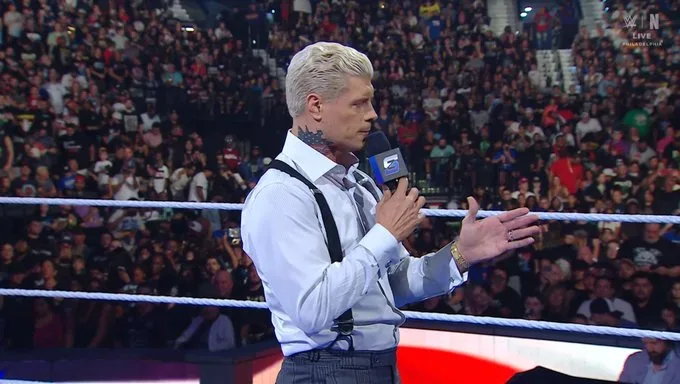
Cody Rhodes says he won’t stop posting about his work with the President’s Council on Sports, Fitness & Nutrition, even if those posts draw criticism. On Stephanie McMahon’s What’s Your Story podcast, Rhodes addressed the reaction that can follow WWE figures’ involvement with the council and explained why he wants to keep bringing attention to its youth fitness events. He acknowledged that some people see a connection to the current administration first. He wants them to look at what the kids are doing first.
The discussion followed an appearance Rhodes made a few months earlier at a Boys & Girls Club of America event in Atlantic City to promote childhood fitness. Rhodes shared a photo from the event with Robert F. Kennedy Jr., the United States secretary of health and human services, and faced criticism from some fans. Earlier in the year, McMahon and Triple H also met with Kennedy to discuss the President’s Council on Sports, Fitness & Nutrition.
Rhodes didn’t hedge when McMahon’s podcast turned to the council. “Here’s my political high horse, and it’s not very political at all,” he said, before making clear that he likes the council and stands behind the fitness work he has been posting about. That opening captured the distinction he made throughout the conversation: He knows the council’s ties to the administration shape how people see a photo, but he doesn’t see the exercises at a youth event as a partisan activity.
Cody Rhodes points to what kids do at the events
Asked to make his case in a setting where he had more room than a social media post, Rhodes got specific about the activities. He mentioned push-ups, sit-ups and shuttle runs, and talked about giving kids a chance to compete with one another and with themselves. Getting them away from their phones was part of the appeal for him, too. His defense centered on those activities rather than on Kennedy’s work as health secretary or on any broader administration policy.
For more background on this topic, read Cody Rhodes Teases Unannounced Acting Project After Playing Guile in Street Fighter.
Rhodes also contrasted visits to what he described as underprivileged areas with visits to top high schools. He brought up both in making the case that the activity itself matters regardless of where it takes place. The competition he described wasn’t only about which kid could do the most repetitions or finish first. He specifically included competing with yourself, a distinction that leaves room for kids who may not be the fastest or strongest in the group.
When Rhodes talked about seeing negative reactions to posts about the council, he summed up his frustration with a question: “Do you know what we’re doing?” That was the point he wanted to get across on the podcast. A photo of Rhodes next to a Cabinet secretary shows who was there, but it doesn’t necessarily tell a fan what happened at the event. The drills and the time spent getting kids active were the details Rhodes wanted to put next to that image.
That explanation doesn’t establish why every fan who criticized the Atlantic City photo did so. Someone can have an objection to the public association with Kennedy without taking issue with children doing push-ups. Rhodes, for his part, described the broader pushback as a reaction to how people feel about the current administration. His answer was to draw a distinction between the government connection people see in the post and the activity he says he is there to support.
Rhodes says he’ll keep sharing the work
Later in the conversation, Rhodes said people had texted him to ask whether he was going to post about the activities. His response was emphatic: “Hell yeah, I’m gonna post.” He went straight back to the example of doing push-ups and sit-ups with kids. In his view, health and fitness are nonpartisan, and the reaction online isn’t a reason to be less public about a cause he feels strongly about.
That was the clearest answer Rhodes gave about what happens after the backlash. He wasn’t just explaining why he shared a photo in Atlantic City. He was saying he’d make the same choice to post about the work again. The podcast gave him a chance to explain that decision in a way the photo alone could not, with the emphasis on why he shows up and why he thinks fans should see that side of the visits.
McMahon’s show was also a notable place for the conversation because she and Triple H had already met with Kennedy about the council. Their meeting and Rhodes’ Atlantic City appearance were separate engagements. The former was a discussion about the council, while the latter was a youth fitness event that Rhodes attended. That distinction matters to his explanation: When he described why he personally backs the effort, he talked about being with the kids and taking part in the exercises, not about what was discussed in a meeting with the secretary.
Rhodes’ comments were a defense of his own participation, not a new announcement about WWE’s involvement or a plan for another event. Nor was he asking wrestling fans to take a position on the administration. What he did say, plainly, was that he likes the President’s Fitness Council and intends to keep posting about the fitness work. His use of “political high horse” acknowledged how the subject can land with fans, even as he spent the rest of the discussion making the case that he doesn’t approach the visits that way.
Rhodes touched on an unannounced project elsewhere in the podcast, but on the fitness council he left little ambiguity. He knows that appearing alongside Kennedy can draw a reaction before anyone asks what the event was for. For Rhodes, the reason to keep showing up and sharing the visits is the part that can get missed in that first reaction: kids putting their phones down, getting moving and trying to do a little better than they did the last time.

Darryl Polo
Darryl Polo is a passionate wrestling fan covering WWE, AEW, TNA and beyond. He loves great rivalries, breakout stars and the moments that keep fans talking long after the bell. How we work.