
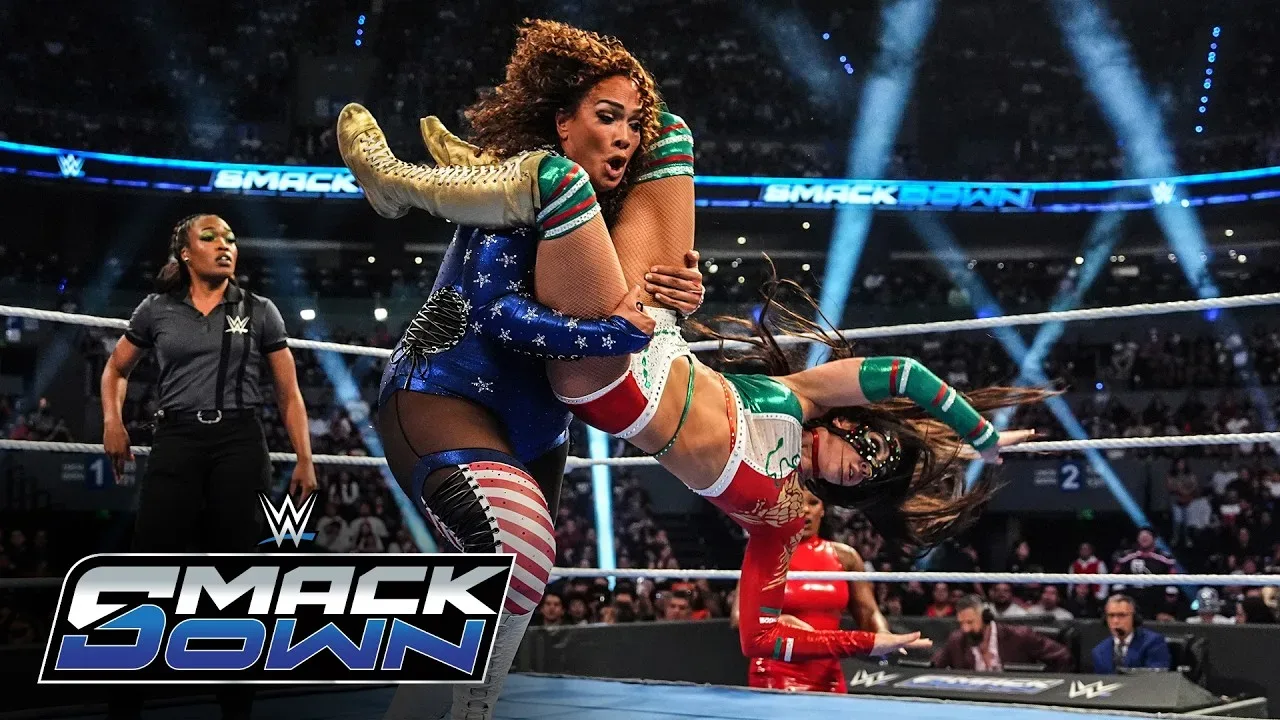
Chelsea Green believes her WWE Women’s Championship defense against Nia Jax on the September 11 edition of WWE SmackDown in Mexico City delivered what it needed to deliver, even if portions of the online reaction did not agree.
Green retained her championship against Jax in Mexico City while working through a broken orbital bone, marking the first successful defense of her title reign. Speaking on NotSam Wrestling, Green discussed the contrast between the energy she felt from the live crowd and the criticism she encountered after the match.
“I thought it was a banger of a match, but the internet told me otherwise,” Green said with a laugh. “One thing about them, they stay humbling me. For 13 years, I can’t get a big head.”
For Green, the response was especially difficult to process because it did not match her experience inside the arena. A loud crowd can shape the way a performer evaluates a match in real time. In Mexico City, Green said she felt that the audience was engaged throughout the contest and that she and Jax had accomplished their core objective: entertaining the people who bought tickets to see SmackDown live.
For more background on this topic, read Carmella Unsure Whether a Full-Time WWE Return Fits Her Family’s Future.
That immediate validation, however, gave way to a very different reaction once she saw opinions circulating outside the building.
“It feels real personal, especially when Mexico City tells you that it was amazing and they are loud the whole time and you come back feeling like, ‘Yes, I just entertained the shit out of them.’ Then, you get a whole different opinion elsewhere. It’s very jarring.”
A Champion’s First Successful Defense
The Mexico City match carried meaningful stakes for Green beyond the standard pressure of appearing on a major weekly WWE television show. It was her first successful WWE Women’s Championship defense, and she entered the bout with a broken orbital bone. That circumstance adds an unavoidable layer to her assessment of the performance.
Professional wrestlers routinely work through physical discomfort, but an orbital injury can present obvious concerns in a match built around physical confrontation. Green did not use the injury as a direct explanation for the negative comments she saw, nor did she frame it as an excuse. Instead, she spoke primarily about the mismatch between a wrestler’s feeling after a hot live performance and the often harsher evaluation that can arrive online.
Her comments underscore a reality of modern wrestling: a match is judged in several different places at once. There is the audience in the venue, whose reactions are immediate and emotional. There is the television audience, which may view the match through a different lens. Then there is the online discussion that continues long after the bell, where criticism can spread quickly and become the dominant part of the conversation even when thousands in the building reacted positively.
Green’s point was not that fans are forbidden from disliking the match. In fact, she acknowledged that she has tried to maintain a balanced perspective toward both praise and criticism. The difficult part, she explained, is deciding how much weight to assign to any reaction in a moment when feedback is so plentiful and so contradictory.
Matt Cardona’s Advice on Online Feedback
During the discussion, Green referenced advice from Matt Cardona that helped put the online criticism into perspective.
“Nobody tweets about a good flight,” Cardona said.
Green said the observation resonated with her.
“When Matt said that, I was like, ‘You are right.’”
The comparison is a simple one, but it gets at a familiar pattern across entertainment, sports, and customer-facing industries. People are often more motivated to post when they are frustrated than when an experience simply met expectations. That does not mean every negative opinion is invalid, and Green did not suggest that it was. Rather, it offers a reminder that the most visible reaction is not always a complete reflection of the audience as a whole.
For a wrestler in Green’s position, that distinction matters. Social-media response can feel immediate, personal, and overwhelming, particularly after a championship match on a prominent televised card. Yet the response inside Arena CDMX, where the match actually unfolded, was the feedback Green had directly experienced. Her recollection of the Mexico City crowd was emphatically positive.
The live environment has long been one of wrestling’s most important measuring sticks. A crowd that remains loud, involved, and emotionally responsive can elevate a match, while silence can make even technically sound work feel flat. Green came away from her title defense believing she and Jax had connected with the fans in the building. The subsequent discourse gave her a sharply different impression, creating the jarring contrast she described.
Trusted Voices and Honest Criticism
Green also explained that she relies on people close to her for more grounded feedback, specifically naming Jordynne Grace as someone who will be honest whether the feedback is welcome or not.
“My friends are also very real with me, like Jordynne Grace, very real, whether I want to hear it or not. She told me she liked the match. That’s who I trust. She would tell me if she didn’t like the match. She would tell me in-depth.”
That distinction is notable. Green is not seeking empty encouragement from those in her circle. She values Grace’s opinion precisely because she believes it would come with detailed criticism if the match had failed to meet her standards. In a profession where performers are constantly receiving feedback from producers, colleagues, fans, and critics, trusted voices can help separate a useful critique from the broader noise of instant online judgment.
Green admitted that she has often preached the importance of accepting both sides of the reaction. If a performer is willing to embrace compliments, she believes that performer should also be prepared to hear criticism. But in the aftermath of the Jax match, she suggested that the volume and inconsistency of opinions made it wiser to step back from all of it for the moment.
“The problem is, I always preach that if I’m going to believe the good stuff, I have to believe the bad stuff. I do stand by that, but right now, I better not believe anything.”
It is an unusually candid description of the emotional balancing act that comes with being a highly visible WWE champion. Wrestlers are expected to have confidence in their work, particularly when carrying a title, but they are also exposed to nonstop evaluation. Green’s response suggests an effort to protect that confidence without becoming dismissive of all criticism.
The Difference Between the Arena and the Timeline
Green’s situation also speaks to the difference between live wrestling and the ongoing conversation surrounding it. The fans in Mexico City were reacting to the match as a full in-person experience: entrances, presentation, atmosphere, championship stakes, and the physical interaction between Green and Jax. Online viewers and commenters may focus on an entirely different set of factors, whether that means match structure, pacing, expectations for the wrestlers involved, or comparisons to other championship bouts.
Neither setting produces a single universal verdict. Wrestling crowds have always varied by city, event, and moment. Digital platforms have only made those differences more visible, allowing every reaction to be recorded, shared, amplified, and debated within minutes.
For Green, Mexico City’s reaction remains a significant piece of the story. The audience was loud, she felt they were entertained, and she left the ring believing the title defense had succeeded. The criticism that followed may have been difficult to read, but it did not erase what happened in the building.
It is also worth noting that Green has not posted on Twitter since July. Her absence from the platform means she has already created some distance from one of the spaces where wrestling discourse moves fastest. While she did not revisit the reasons for leaving Twitter during these comments, her remarks about the reaction to the Jax match illustrate why managing online feedback can be challenging for performers.
What Comes Next for Green
Green remains WWE Women’s Champion following her victory over Jax, and her focus will now turn toward the next challenger to her reign. The Mexico City defense established an important early marker: she retained in a featured championship situation while dealing with a broken orbital bone and performed before a highly engaged international crowd.
Whether fans viewed the match as a success or not, Green has made clear that she is not allowing one wave of online criticism to fully dictate her own view of the night. She heard the negative response, considered it, and weighed it against the live atmosphere and the assessments of people whose honesty she trusts.
In the end, Green’s reaction is less about asking audiences to share one opinion of her match with Nia Jax than it is about recognizing how many competing opinions now surround every major wrestling performance. Mexico City gave her one answer. The internet gave her another. As champion, Green is attempting to keep perspective while moving forward from both.

Darryl Polo
Darryl Polo is a passionate wrestling fan covering WWE, AEW, TNA and beyond. He loves great rivalries, breakout stars and the moments that keep fans talking long after the bell. How we work.