
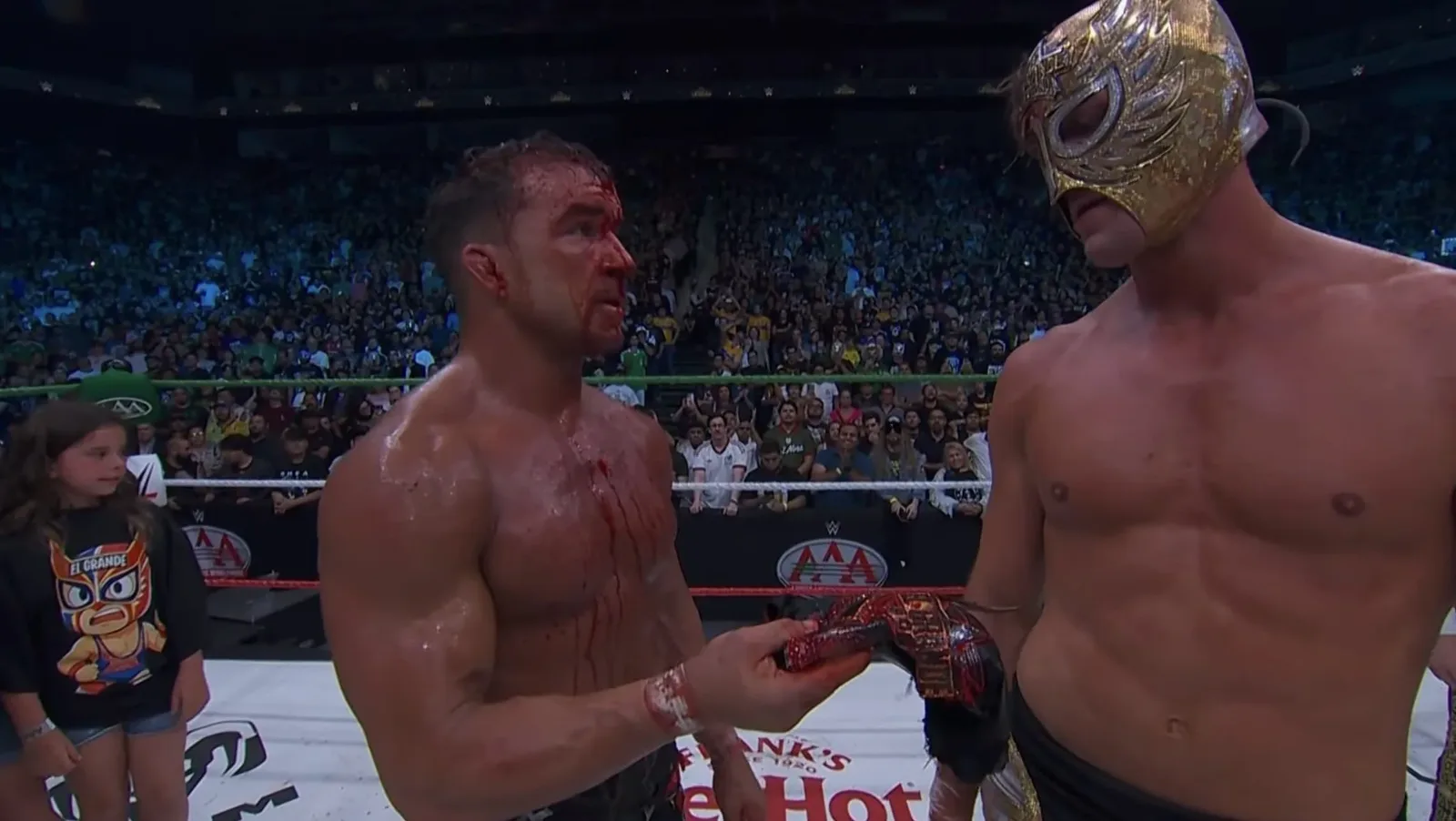
Chad Gable’s time in Lucha Libre AAA may have ended in a mask vs. mask defeat, but the WWE Intercontinental Champion says the experience had a lasting personal impact beyond the outcome in the ring.
Gable’s AAA run began when he appeared as the original El Grande Americano, a character that became central to an unusual and increasingly personal story. That chapter came to a close in May 2026, when Gable lost a mask vs. mask match to another El Grande Americano, revealed as Ludwig Kaiser. Reflecting on the run, Gable explained that working through the situation brought him face-to-face with a familiar instinct from his amateur wrestling background: the need to satisfy the coaches and mentors whose opinions he values.
Speaking with Chris Van Vliet, Gable said that desire to earn approval has been ingrained in him for much of his life. He connected that mindset to the pressure he felt while performing in AAA and trying to deliver what The Undertaker wanted from him.
“Sure. I’ve had coaches my whole life, whether it’s my high school coaches, Greco-Roman coaches, that I’ve always looked up to and wanted to appease, and I’ve wanted to make them happy and satisfied with my performance,” Gable said. “That’s been a goal of mine. It’s just bred into me from amateur wrestling. It’s a trait that doesn’t always serve me well, but it’s just that’s part of me, and that was happening with Undertaker in AAA.”
For more background on this topic, read Jacy Jayne Admits to Nerves Before First WWE Money in the Bank Ladder Match.
Gable identifies the pressure behind his AAA struggles
Gable’s comments frame his AAA run as more than a change of costume or a storyline detour. He described a period in which he believed he was falling short of expectations, and he made clear that it weighed heavily on him. For a performer who built his sporting identity in the highly structured world of amateur wrestling, the feeling that he was not delivering for someone he respected became difficult to ignore.
“I don’t feel like I was giving him what he was looking for the longest time down there, and it bothered the hell out of me,” Gable said. “Deep down to my core, it taught me a lot about myself actually — self-realization about who I’m trying to please and why and all these things.”
The admission offers insight into how Gable approached the El Grande Americano role. His career has long been defined by technical excellence, competitive intensity and an obvious connection to his Greco-Roman background. Yet his reflection suggests that the AAA material challenged him in a different way. Rather than simply attempting to execute a role correctly, Gable had to confront why outside validation held such power over him.
That distinction matters in an industry where performers are routinely asked to adapt. A wrestler can be asked to change presentation, alter their in-ring approach, embrace comedy, become more serious, work with unfamiliar opponents or adjust to the expectations of a different audience. Gable’s description of the experience highlights the internal part of that adjustment. The issue was not only whether the character worked, but whether he could stop treating every performance as an attempt to win approval.
The ringside brawl that changed Gable’s approach
Gable said he ultimately turned that frustration into a mission. He wanted to demonstrate that he could provide the kind of performance The Undertaker was seeking. The breakthrough, in Gable’s view, came during his first ringside brawl with the other El Grande Americano.
“But I made it a mission. I’m like, no, I’m gonna show him that I can give him what he’s looking for, and it was that night that I did the first brawl, the ringside brawl with the other El Grande, where he finally convinced me just let it go, just show me who you are,” Gable said.
The phrase “just let it go” appears to be the central lesson Gable took from the program. He had spent much of the run trying to identify and meet a perceived expectation. At the moment he found a greater sense of freedom, he says, the instruction became simpler: stop forcing the performance and reveal more of himself.
That does not diminish the importance Gable places on coaching. His comments make the opposite clear. He has deep respect for coaches from his high school and Greco-Roman wrestling days, and he openly recognizes how their standards shaped his mentality. But he also acknowledged that the same trait that drove him to improve can have drawbacks. The need to please an authority figure can become limiting if it prevents a performer from trusting their own instincts.
For Gable, the AAA run became an exercise in finding a balance between discipline and spontaneity. His athletic foundation gave him the habits to study, prepare and chase improvement. The El Grande Americano story seemingly pushed him to access a more instinctive side of his work. His recollection of the ringside brawl suggests that this was the point where those qualities began to meet.
The original El Grande Americano’s story ended with Ludwig Kaiser
The on-screen conclusion to Gable’s AAA chapter arrived in May 2026. Gable, as the original El Grande Americano, faced El Grande Americano in a mask vs. mask match and was defeated. Ludwig Kaiser was identified as the rival El Grande Americano, bringing the storyline to its decisive finish.
Mask vs. mask matches carry considerable stakes by design. In this case, the stipulation made the closing chapter of Gable’s run especially definitive. The loss ended his time in AAA under the El Grande Americano identity, but Gable’s remarks show that he does not view the experience solely through the lens of the defeat. Instead, he sees it as a period that exposed a deeply rooted part of his personality and helped him reconsider how he measures his own work.
That perspective is notable because wrestling narratives often encourage audiences to focus on wins, losses, championships and reveals. Those elements were certainly present in Gable’s program: a masked identity, a rival carrying the same name, a major stipulation and Kaiser’s eventual unmasking. But Gable’s own takeaway is more personal. He emphasized the challenge of learning not to chase someone else’s ideal version of his performance at the expense of his own identity.
What the experience means for the Intercontinental Champion
Gable now holds the WWE Intercontinental Championship, placing him in one of WWE’s most prominent positions. His comments about AAA do not present the run as a separate footnote to his career. They instead describe a learning experience that arrived during an active and important stage of his professional journey.
As Intercontinental Champion, Gable has a platform that puts additional attention on every defense, promo and character decision. The same drive that led him through amateur wrestling and into WWE will remain a strength. At the same time, his reflection indicates a more nuanced understanding of that drive. He knows the desire to meet expectations is a part of him, while also recognizing that it cannot be allowed to dictate everything he does.
There is a practical lesson in Gable’s account for any performer navigating high-pressure creative environments. Preparation and a willingness to take direction are essential, but a wrestler also needs the confidence to bring their own personality to the role. Gable believes he found that confidence during the confrontation with Kaiser’s El Grande Americano, when he was encouraged to stop holding back and simply show who he was.
His AAA run ended with the loss of the mask, but Gable’s own description gives the story a different kind of conclusion. The experience taught him about the instincts that motivate him, the costs of trying too hard to please others and the value of trusting himself when the moment calls for it. For the WWE Intercontinental Champion, that realization may be the most meaningful result to come out of El Grande Americano’s time in AAA.

Darryl Polo
Darryl Polo is a passionate wrestling fan covering WWE, AEW, TNA and beyond. He loves great rivalries, breakout stars and the moments that keep fans talking long after the bell. How we work.