
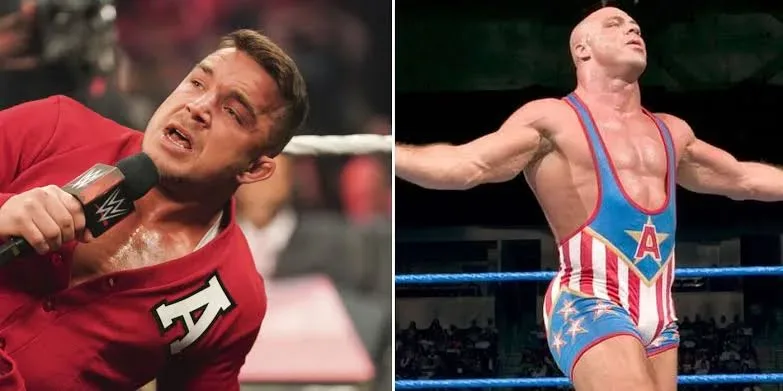
Chad Gable understands why wrestling fans would want to know what would happen if he and Kurt Angle got on a mat together. He just doesn't see a good reason to find out. In an interview with The Wrestling Classic, Gable addressed why he and the WWE Hall of Famer never tested each other in amateur wrestling. His answer wasn't a prediction about who would win. It was a question of what either man would get out of settling it in the first place.
“I’ve got nothing to prove to anybody.”
Gable's concern was that grappling with Angle would be more likely to create problems than accomplish anything worthwhile. He didn't put forward a challenge or offer a result for a match that never happened. That distinction matters in wrestling, where an answer about a hypothetical opponent can quickly turn into a debate over who would beat whom. Gable's point was that the debate itself wasn't enough of a reason to have the match.
Gable and Angle reached the Olympics in different styles
Angle won freestyle wrestling gold at the 1996 Olympics in Atlanta, competing at 100 kilograms. Gable represented the United States at the 2012 Olympics in London in Greco-Roman wrestling at 84 kilograms. WWE fans are used to hearing both men described as Olympians, but that shorthand leaves out one of the most interesting parts of the comparison: They reached that level in different disciplines and competed in different weight classes.
For more background on this topic, read WWE Survivor Series 2026 Preview: Start Time, How to Watch and Full WarGames Card.
In Greco-Roman, wrestlers cannot grab below the waist or actively use their legs to execute holds. Freestyle allows attacks on the legs, along with a wider range of ways to use them in offense and defense. Put the two men under freestyle rules and Angle would be working in the style in which he won gold. Make it a Greco-Roman bout and Gable would be working under the rules that took him to London. Neither observation tells you who would win. It does show why an informal exchange wouldn't necessarily answer the broad question of which man was the better wrestler.
There's a difference between a practice session and the kind of contest people imagine when two famous wrestlers are asked if they've ever gone at it for real. In a room, one exchange can start from a particular position or be about trying a specific technique. Once that exchange is treated as a verdict on two careers, the context tends to disappear. Angle's Olympic gold is already part of the record. So is Gable's place on the U.S. Olympic team. A result in a different setting wouldn't add to or take away from either accomplishment.
Why WWE fans make the comparison
Angle and Gable both carried recognizable pieces of their amateur wrestling into WWE. Both made the ankle lock a familiar part of their matches, and both used suplexes and quick changes of position to make their amateur credentials visible to the audience. You didn't need to know the difference between freestyle and Greco-Roman to understand, from watching them work, why WWE made their backgrounds part of their presentation.
They reached WWE audiences in different ways, though. Angle arrived with an Olympic gold medal that WWE made central to his character, whether he was asking fans to celebrate his achievements or giving them reasons to boo him. Gable first broke through as a tag team wrestler alongside Jason Jordan in American Alpha. Their timing and tandem offense helped make them stand out in NXT, where they won the tag team championship before going on to win the SmackDown Tag Team Championship. Gable's amateur technique was part of the appeal, but the team gave him a way to showcase it without simply following Angle's path.
Jordan is another reason the names tend to come up together. After wrestling alongside Gable in American Alpha, he became part of a WWE storyline in which Angle revealed him as his son. That gave fans a direct on-screen connection between Angle and Gable's former partner, even though the storyline had nothing to do with whether Gable and Angle ever met in amateur competition. It's a useful reminder of how easily a WWE association and a real sporting comparison can get folded into the same conversation.
A WWE match would have asked a different question
A professional wrestling match between Angle and Gable would have offered something that a private grappling session couldn't: the chance to see how two performers with related but distinct styles built a match together. The obvious hook would have been the technical exchanges. The more revealing part might have been what each did once the other blocked a familiar move or turned a signature hold against him. Those are reasons to wonder what the two could have done in a WWE ring, not reasons to assume a genuine competitive bout needed to happen.
Angle's final WWE match came against Baron Corbin at WrestleMania 35 in 2019. Gable has gone on to build his own identity, including as the leader of Alpha Academy. The resemblance to Angle remains easy to spot when Gable uses the ankle lock, but it doesn't explain everything about his work. His tag team success and his later role as a demanding coach gave audiences ways to respond to him beyond simply recognizing that he had been an Olympian.
Gable also discussed not being part of Team USA against Team Mexico elsewhere in the interview. That was a separate subject from the question about Angle, even if both bring up Gable's association with representing the United States. His comments on Angle were about the value of one specific matchup, not a statement that his amateur background no longer matters to him or to his work in WWE.
The question will probably keep coming up because so few WWE wrestlers can compare actual Olympic experiences. But Gable didn't claim he would beat Angle, and he didn't concede that Angle would beat him. He drew a line between the curiosity that makes the matchup fun to talk about and the idea that either wrestler has unfinished business on the mat. The first is understandable. The second isn't something Gable believes he needs to settle.

Darryl Polo
Darryl Polo is a passionate wrestling fan covering WWE, AEW, TNA and beyond. He loves great rivalries, breakout stars and the moments that keep fans talking long after the bell. How we work.