
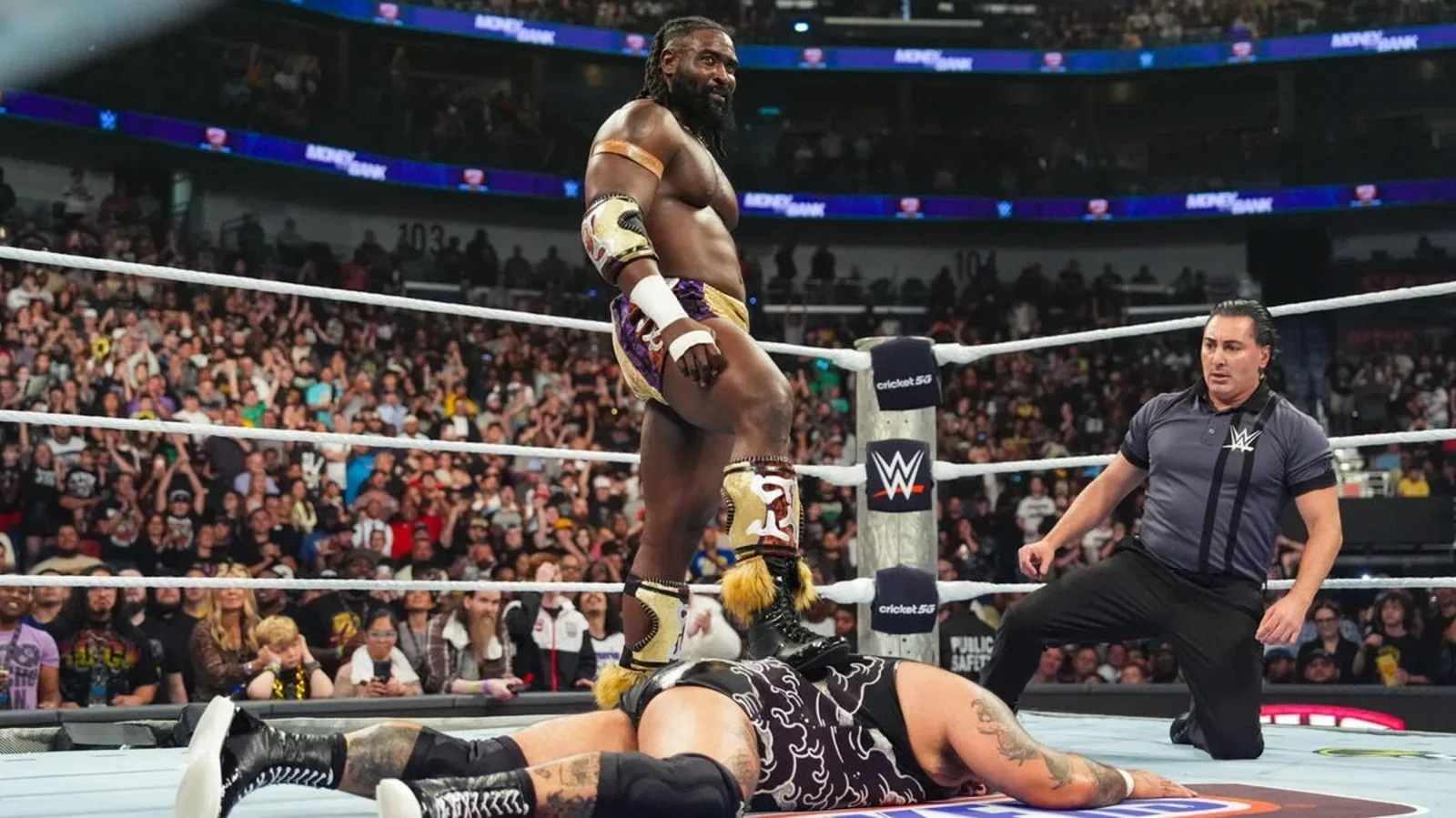
Oba Femi’s victory over Bronson Reed at WWE Money in the Bank continued the powerful upward momentum behind one of the company’s most imposing young stars. Femi survived interference from The Judgment Day, endured two brass knuckles shots from Reed, kicked out after a Tsunami, and then put Reed away with a moonsault followed by Fall From Grace.
For Bully Ray, however, the issue was not the result. The veteran performer and outspoken wrestling analyst made clear that he has enjoyed Femi’s presentation to this point. His concern centered on how much punishment WWE had Femi absorb during the match’s biggest near-fall sequence.
Speaking on Busted Open, Ray said the brass knuckles portion of the bout pulled him out of the action. In his view, Reed landing two shots to Femi’s jaw with a foreign object, then following up with his signature Tsunami splash, made the eventual kick-out harder to accept than it needed to be.
“I’ve been loving everything from Oba up until Saturday night,” Ray said. “They lost me a little bit on Saturday.”
For more background on this topic, read Drew McIntyre Says ‘Hollywood Drew’ Is the Priority as He Keeps Himself Ready for WWE Return.
The sequence that bothered Bully Ray
The story of the match placed Femi against more than just Reed. The Judgment Day became involved as expected, creating the sort of chaotic environment that can give a dangerous powerhouse like Reed a major advantage. Reed was also given brass knuckles during the contest, and he used them on Femi twice.
That escalation was designed to frame Femi as exceptionally difficult to defeat. Reed did not simply use an illegal shortcut and immediately cover his opponent. He struck Femi twice in the jaw with the knuckles, hit the Tsunami, and still could not keep him down for three seconds.
Ray’s argument was that the sequence crossed from highlighting Femi’s toughness into undermining the basic credibility of the offense. He repeatedly questioned whether two brass knuckles blows to the face from an athlete with Reed’s size and power should leave any opponent capable of immediately surviving a top-rope splash.
“Two shots to the jaw with brass knuckles? You don’t think that’s a little much?” Ray asked.
Ray did not dismiss the Tsunami as a believable match-ending move. In fact, he said that part of the sequence was understandable because Reed’s splash is already established as a major weapon. His objection was specifically to adding two direct brass knuckles shots before it, particularly given that Reed remains an enormous physical presence even after losing weight.
The broader point was one of match structure. In wrestling, a performer can survive extraordinary punishment when the story gives viewers a reason to believe that athlete is special. But every additional dramatic escape sets a higher bar for the next one. Ray felt that the Money in the Bank match gave Femi too many obstacles in too short a span, making the intended drama feel less organic.
A question of protecting offense and protecting Femi
Femi’s resilience is clearly an important part of his WWE identity. He is presented as a rare combination of size, athleticism, explosiveness, and confidence. That presentation was on display again in the finish, where he was able to come back from Reed’s assault and deliver a moonsault before using Fall From Grace to secure the win.
There is a fine balance in booking a dominant rising star, though. The goal is often to show that the wrestler can endure adversity without making the opposition’s biggest offense seem ineffective. Ray’s criticism suggested that WWE could have reached the same destination with a sequence that protected both men more cleanly.
He argued that Femi kicking out after multiple Tsunamis would have been easier to accept than Femi absorbing the knuckles shots. That alternative would still establish Reed as a threat, preserve the idea that his splash can finish opponents, and portray Femi as a uniquely difficult obstacle to overcome. It also would avoid asking the audience to overlook the expected impact of a weapon-assisted blow to the jaw.
“That, to me, is a force feed,” Ray said, explaining that the knuckles strikes took him “out of the moment.”
Ray also stressed that the objection was not about treating professional wrestling as a literal combat sport. Wrestling naturally relies on heightened drama, spectacular comebacks, and performers taking punishment that would be impossible in a real fight. His issue was internal logic: once a match establishes that a wrestler has been struck cleanly in the jaw with brass knuckles, the audience has to be given a compelling reason to believe that wrestler can keep fighting as though the damage was not decisive.
Femi’s physical profile may invite WWE to present him as nearly unstoppable, but Ray’s view was that one brass knuckles shot would have been sufficient if the company wanted to emphasize his durability. Two shots, combined with the Tsunami, was where the match crossed his personal threshold for believability.
Why the criticism matters for Oba Femi’s presentation
Ray’s comments were not framed as a rejection of Femi himself. Quite the opposite: he described himself as someone who has been enjoying Femi’s work and the way he has been positioned. That distinction is important. The concern was about the creative choice made within one major match, not a suggestion that Femi should be portrayed as less significant.
In many ways, the critique reflects the expectations that accompany Femi’s rise. WWE has built him as a performer who should feel different from the rest of the roster. When a talent is given that kind of aura, fans and analysts will closely examine every major test, every dramatic kick-out, and every finish to determine whether the presentation is making the star feel stronger or simply making the match feel excessive.
Reed is also not an opponent whose offense can casually be dismissed. He is among WWE’s most physically intimidating wrestlers, and the Tsunami is designed to be devastating. Adding The Judgment Day’s interference and the brass knuckles created a scenario in which Reed had every possible advantage. Femi surviving that situation certainly sends a message about his standing, but Ray believes the message could have been delivered with less.
That is the central tension behind the discussion. A match can use an extreme escape to make a rising star look superhuman, yet it can also risk weakening the danger associated with an established opponent’s signature offense. WWE chose the first approach at Money in the Bank. Ray would have preferred a version that leaned more heavily on Reed’s splash rather than weapon shots to create the climactic drama.
Femi leaves Money in the Bank with another major win
Despite the debate over the match layout, the final result was unambiguous. Femi defeated Reed after surviving the interference and Reed’s biggest attacks. His moonsault shifted the momentum, and Fall From Grace ended the contest.
The win adds another notable chapter to Femi’s WWE ascent and reinforces the company’s faith in him as a top-level attraction. He was placed in a high-profile match against a formidable opponent, put through an elaborate disadvantage scenario, and emerged victorious.
For Ray, the takeaway is less about changing Femi’s destination than refining the route WWE takes to get there. He wants Femi to look powerful and exceptional, but he also wants the audience to feel the weight of major strikes, weapons, and signature moves. In his view, preserving that sense of consequence will ultimately make Femi’s biggest victories feel even more meaningful.
Money in the Bank showed that WWE is willing to present Femi as a man who can withstand extraordinary punishment. Ray’s response serves as a reminder that the strongest monster-style booking often comes not from having a star survive everything, but from carefully choosing the moments when survival feels truly impossible.
In pictures

Darryl Polo
Darryl Polo is a passionate wrestling fan covering WWE, AEW, TNA and beyond. He loves great rivalries, breakout stars and the moments that keep fans talking long after the bell. How we work.