
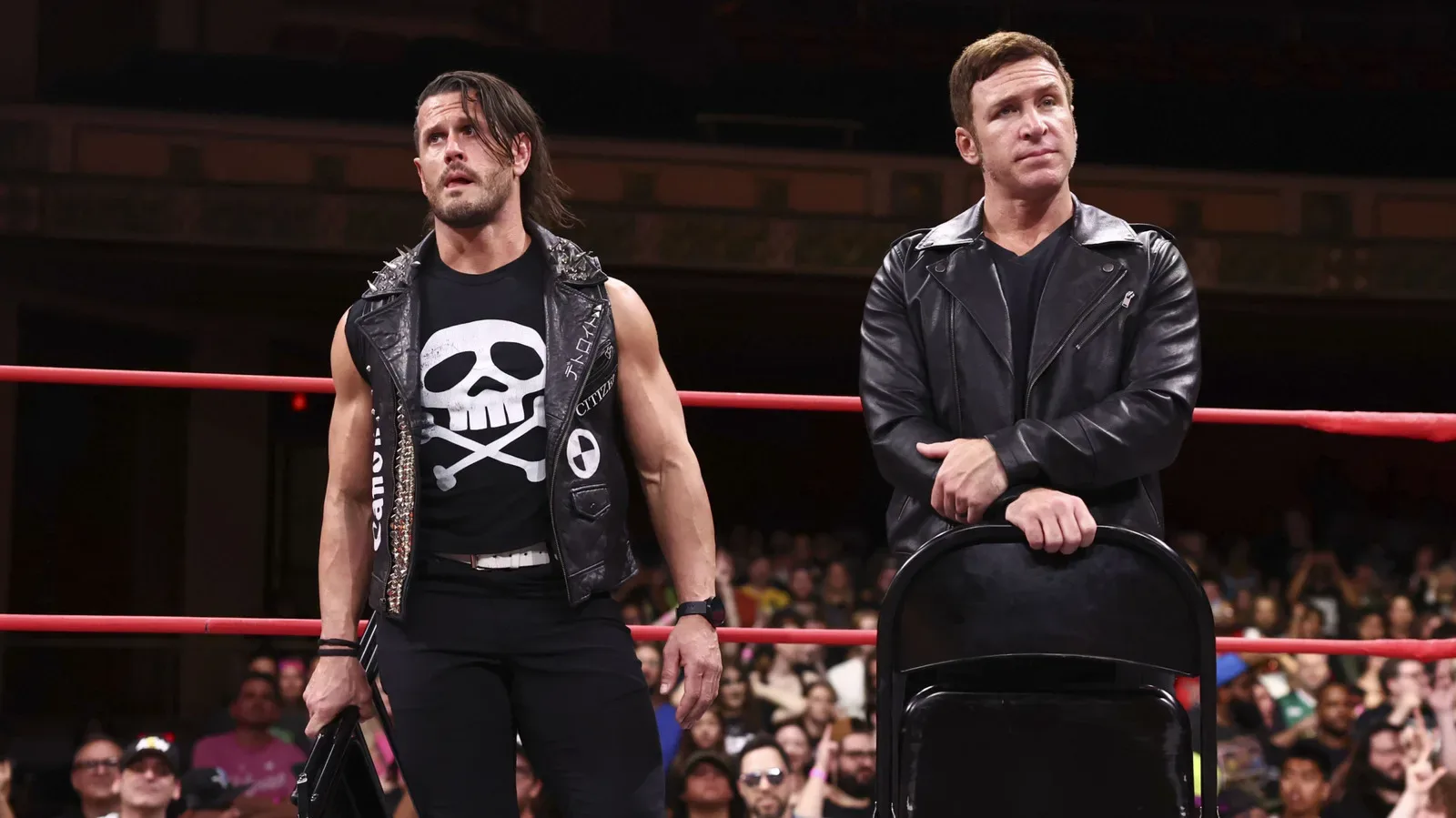
The Motor City Machine Guns have earned admiration throughout their career for their speed, timing, versatility and ability to make a tag team match feel like a major attraction. For Bully Ray, however, Alex Shelley and Chris Sabin represent more than a celebrated opponent from TNA’s tag team scene. Their rivalry with Team 3D helped set the stage for one of the most consequential creative turns of his career: the split from D-Von Dudley and the eventual emergence of the Bully Ray persona.
Speaking on Busted Open Radio, Bully Ray looked back on the early stages of Team 3D’s program with Shelley and Sabin. He explained that the teams did not immediately see wrestling the same way, which required an adjustment period before the rivalry found its rhythm. Once that understanding was established, Bully Ray felt the contrast between the veteran powerhouse team and the innovative younger duo produced something special.
“I personally chose the Machine Guns — specifically Chris Sabin — to be the first person to ever kick out of the 3D,” Bully Ray said on Busted Open Radio.
That decision carried substantial weight because the 3D was not treated as an ordinary move. As Team 3D’s defining finishing maneuver, it was a major storytelling device in every match and feud built around the decorated duo. Having someone survive it was therefore a statement of confidence, and Bully Ray said Sabin was the wrestler he selected to make that historic kickout.
For more background on this topic, read Ava Explains Why She Felt It Was Time to Leave WWE.
More importantly, Bully Ray connected that moment directly to the storyline direction of Team 3D. The conclusion of the rivalry in 2010 did not simply close the book on a notable tag team feud. It became part of the narrative foundation for Bully Ray and D-Von going in different directions.
“Him kicking out of the finish and being the first one was obviously a big deal, but that’s what led to me and D-Von going our separate ways,” Bully Ray said.
A pivotal moment in a high-profile TNA rivalry
The Motor City Machine Guns’ feud with Team 3D came during the earlier portion of Shelley and Sabin’s TNA run, when the Guns were establishing themselves as one of the promotion’s premier tag teams. The matchup was built on an appealing difference in styles. Team 3D brought experience, size and an intimidating physical identity, while Shelley and Sabin represented a quicker, more explosive and more unconventional approach to tag team wrestling.
Bully Ray acknowledged that those contrasting philosophies initially made it necessary for both sides to find common ground. That is often the challenge of a major tag team rivalry: the teams need more than contrasting personas or signature moves. They need a shared sense of pacing, escalation and what each side is trying to accomplish within the story.
In Bully Ray’s view, Team 3D and the Motor City Machine Guns ultimately achieved that connection. He described the results once they were aligned as “magic,” a reflection of the level of trust and cooperation required to present a meaningful program between two established teams with distinctly different identities.
The decision to have Sabin kick out of 3D was an example of that trust. Such a moment does not merely create a dramatic near fall. It changes the audience’s understanding of the opponent. The wrestler who survives is immediately positioned as resilient enough to withstand something previously treated as definitive, while the team using the move must confront the emotional and competitive consequences of seeing its most dependable weapon fail to end the match.
For the Team 3D story, that consequence became a catalyst. Bully Ray’s recollection makes clear that Sabin’s kickout was designed to serve both the immediate rivalry and the next chapter in the Team 3D narrative. The MCMG feud was therefore not isolated from Bully Ray and D-Von’s subsequent split; it was an important piece of the road leading there.
Bully Ray praises Shelley and Sabin as opponents and performers
While discussing the past, Bully Ray also offered strong praise for both members of the Motor City Machine Guns. He said he loved working with Shelley and Sabin, describing them as an exciting tag team and speaking warmly about them personally.
“Loved working with them. Exciting tag team,” Bully Ray said. “I would’ve loved to see more from them in the WWE, but it’s not easy to survive as a traditional tag team in the WWE, and I wish them well no matter where they wrestle on the planet. They’re really good dudes.”
That assessment comes as the Motor City Machine Guns begin another chapter in AEW. Shelley and Sabin are now with the promotion after departing WWE in the spring, bringing a long shared history and an established identity to the AEW tag team division.
The pair appeared for AEW during the summer and returned to in-ring action for the company earlier this month. Their latest involvement follows their previous one-off AEW appearance at the 2022 edition of All Out. For a team whose reputation has been built around longevity as well as in-ring chemistry, their return gives AEW another recognizable tandem with an extensive body of work behind it.
The value of a traditional tag team
Bully Ray’s comments also underline a wider point about the Motor City Machine Guns’ standing in modern wrestling. Shelley and Sabin are not simply two singles wrestlers who occasionally align. Their legacy is rooted in functioning as a true unit: a team with a shared name, shared history, coordinated offense and a catalog of matches that has made them a reference point for later generations of tag wrestlers.
That traditional team identity was central to why the Team 3D rivalry carried such significance. It was not a situation in which an established team was facing a temporary pairing. It was a meeting between two duos whose credibility depended on teamwork, timing and their ability to make their partnership feel indispensable.
It also made Sabin’s kickout particularly memorable from a narrative perspective. The moment did not just elevate one athlete against a legendary finishing move. It helped frame the Motor City Machine Guns as opponents worthy of changing the expectations around Team 3D, one of the most feared and recognizable teams in the sport.
For Bully Ray, the moment remains personally significant because of where it led. His eventual separation from D-Von created a new direction for his character and became one of the defining developments to come out of that period. By linking the split to Sabin becoming the first wrestler to kick out of 3D, Bully Ray identified the Guns’ feud as a key turning point rather than simply another entry in Team 3D’s extensive rivalry list.
Motor City Machine Guns begin their latest AEW run
As Shelley and Sabin continue in AEW, Bully Ray’s reflections provide added context for the stature they bring with them. Their history includes high-level competition against established stars and teams, and their work with Team 3D stands as an example of the impact they were able to have even while sharing the ring with veterans who had already built a formidable legacy.
The praise is also notable because it comes from a rival who was directly involved in one of the Machine Guns’ most important stories. Bully Ray was not simply offering a general compliment about their talent. He pointed to a specific creative choice involving Sabin, the first kickout of 3D, and explained how it affected the direction of Team 3D itself.
That is the lasting importance of the moment. It elevated Sabin, strengthened the Motor City Machine Guns’ position in the rivalry and gave Team 3D’s story a reason to move into a new phase. Years later, with Shelley and Sabin again performing in AEW, Bully Ray’s comments reinforce the degree to which the Machine Guns have left a mark on every major stop of their shared career.
For AEW, the addition of an experienced, cohesive and widely respected team creates fresh possibilities. For Bully Ray, it also serves as a reminder of a rivalry that helped deliver memorable tag team wrestling while changing the course of his own partnership with D-Von. The Motor City Machine Guns were influential opponents then, and their arrival in AEW ensures their next chapter will be watched closely.
In pictures
Darryl Polo
Darryl Polo is a passionate wrestling fan covering WWE, AEW, TNA and beyond. He loves great rivalries, breakout stars and the moments that keep fans talking long after the bell. How we work.