
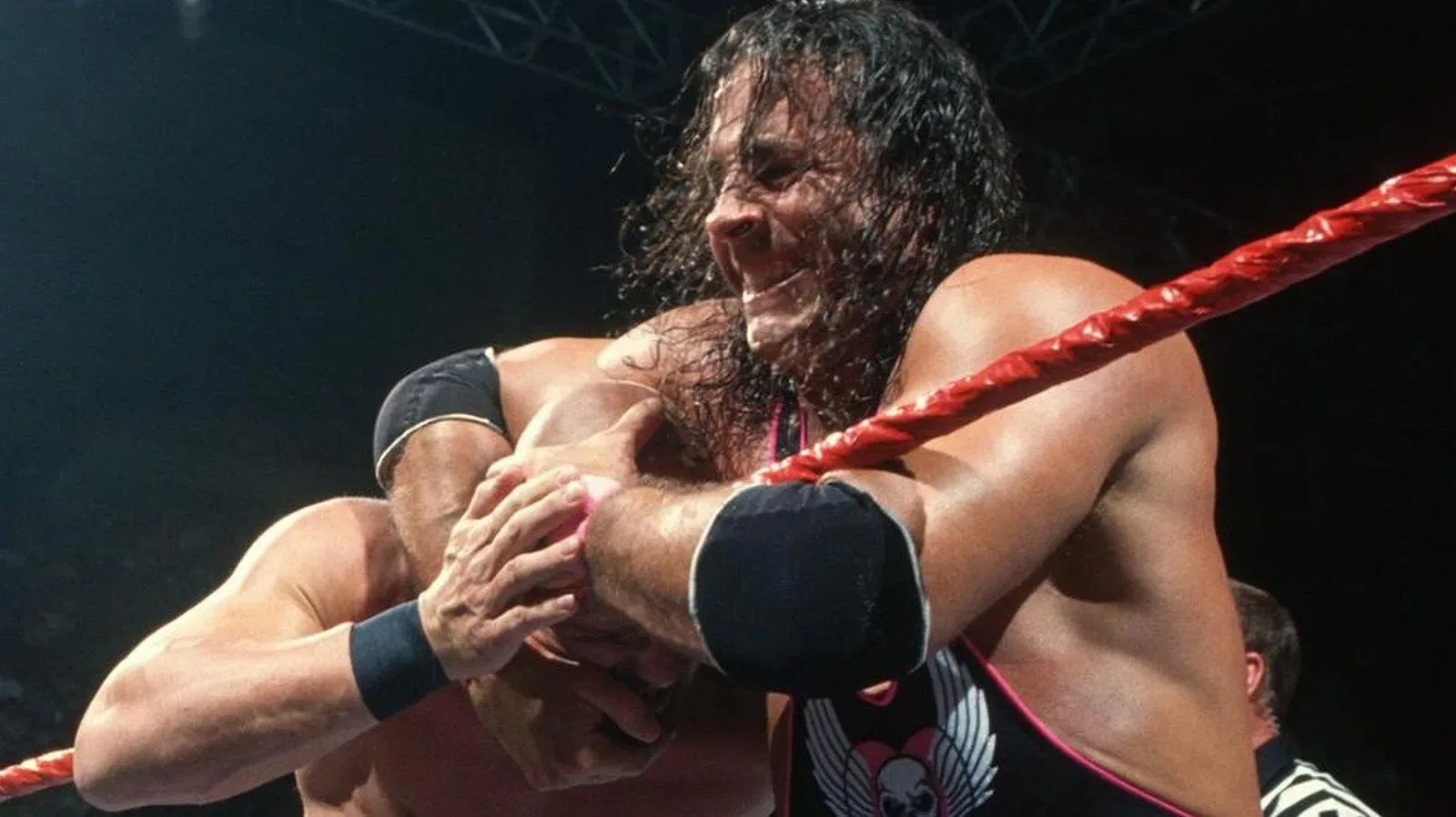
Bret Hart has never been shy about defining what professional wrestling should look like. The WWE Hall of Famer built one of the most respected careers in the industry through a style centered on crisp fundamentals, technical precision, urgency and an unwavering commitment to making every exchange believable. In a new appearance on the Johnny I Pro Show, Hart revisited that philosophy and offered a pointed assessment of what he believes is absent from too much modern wrestling.
Hart’s central argument is simple: even though professional wrestling is a performance, its best version has to convince viewers that what they are seeing could be real. He feels wrestlers today are not consistently putting enough effort into creating that illusion.
“I always have a line that I use regularly: the best pro wrestling has to always pretend to be real. And I don’t think they’re trying hard enough anymore to make it appear real,” Hart said on the Johnny I Pro Show.
The comment fits closely with the standards Hart has championed throughout his career. Long before becoming a singles world champion and one of WWE’s defining performers of the 1990s, Hart developed within the Hart family’s wrestling environment, where grappling credibility and detail in the ring were treated as necessities rather than optional additions. His most celebrated matches often had an athletic pace, but they were also structured around holds, counters, body-part work and a clear sense that winning required strategy.
For more background on this topic, read Royce Keys Says Mark Henry Is the WWE Legend He Would Add to 946.
Hart did not present his criticism as a rejection of every wrestler working today. In fact, he made clear that there are many current performers he likes. His concern is more specifically with a broader approach to match construction and presentation, one he believes too often prioritizes spectacle without enough of the physical connective tissue that lets viewers invest in the action.
“I was always a fan of good, real wrestling,” Hart said. “I love a lot of wrestlers that are working today, but you know, for God’s sake, maybe they could put a hold on once in a while?”
Hart’s Preference For Wrestling That Looks Competitive
During the interview, Hart recalled watching footage of wrestlers from the 1960s and pointed to that era’s style as closer to what he wants from the business. He described the approach as being more rooted in Greco-Roman wrestling than much of the product seen today. That does not mean every match from a previous generation was a pure mat-wrestling exhibition, but Hart’s larger point is that older bouts more regularly established a sporting foundation.
In that framework, a lockup matters. A wristlock is not merely a pause before the next major move; it is a chance for one competitor to take control, for the other to escape, and for the audience to understand the stakes of a struggle. A wrestler selling a damaged leg, ribs or arm provides continuity from one sequence to the next. Those elements, in Hart’s view, help a match resemble a contest rather than a collection of predetermined moments.
Hart’s own body of work offers plenty of examples of that philosophy. Whether he was wrestling a major rival, defending a championship or working a television match, his offense and selling were usually designed to support a recognizable story. His Sharpshooter was treated as the destination of a match, not simply a familiar pose for the crowd. Opponents escaping it, fighting toward the ropes or having a leg weakened before the hold was applied all reinforced the logic of the contest.
That attention to detail helped make Hart an influential figure for generations of wrestlers. Many performers who followed him have borrowed from his technical approach, his pacing, or his emphasis on making a match build toward a meaningful finish. Yet Hart’s latest comments show that admiration for his work has not necessarily changed his view that wrestling should always protect its core illusion.
Kayfabe Has Changed, But Hart Still Values Suspension Of Disbelief
Hart acknowledged that the relationship between wrestling and its audience has changed dramatically. Kayfabe, the traditional practice of presenting the industry and its storylines as real, does not carry the same importance it once did. Modern fans have unprecedented access to behind-the-scenes interviews, social media exchanges, documentaries and programming that openly examines how WWE operates.
He specifically referenced WWE Unreal while discussing how much the curtain has been pulled back for viewers. Hart did not deny that contemporary audiences understand the nature of the business. Rather, his point was that knowing wrestling is scripted does not eliminate the need for wrestlers to make the performances themselves convincing.
That distinction has long been central to debates about wrestling. Fans may know the outcomes are planned, but they can still react emotionally when a match has internal logic, when a character’s actions make sense, and when the physicality appears earned. In Hart’s estimation, the performer’s responsibility is to preserve that emotional investment by treating the action with seriousness.
Hart said that he and his contemporaries made a conscious effort to suspend disbelief. Even as someone working inside the industry, he explained that he could occasionally become caught up in what he was watching when the wrestling was performed at a high enough level. That is a significant standard coming from a wrestler who spent decades around the mechanics of the business and understood exactly how matches were put together.
The implication is not that modern wrestling must abandon athletic innovation, high-risk moves or the fast-paced sequences that have become popular across major promotions. Hart’s concern is that these elements work best when they are anchored by credible movement, consequences and emotion. A thrilling exchange can be even more effective if the audience believes the wrestlers are fighting to gain an advantage instead of simply waiting for their next choreographed opportunity.
The Continuing Debate Over Style
Hart’s perspective arrives amid an ongoing discussion about what audiences want from professional wrestling in 2026. The industry contains a wide range of styles: technical wrestling, heavyweight brawling, aerial offense, hardcore matches, comedy and cinematic storytelling all coexist. WWE itself has featured performers with dramatically different approaches, from wrestlers who emphasize mat technique to others whose appeal is built around explosive power, personality or elaborate spectacle.
There is no single formula that guarantees a great match, and Hart’s comments do not suggest that every wrestler must work exactly as he did. Instead, he is advocating for a principle that can apply to nearly every style. A high-flyer can make their risk feel more meaningful by selling the impact of a landing. A powerhouse can make an opponent’s comeback resonate by showing that a hold or targeted attack has weakened them. A technical wrestler can avoid empty repetition by ensuring each transition has a clear purpose.
Believability is also tied to character. When a wrestler responds to a situation consistently, fans have a stronger understanding of who that person is and what they are willing to do to win. When the action is treated as consequential, the audience has more reason to care about the result. Hart’s call for more holds is therefore not only about nostalgia for a slower style; it is about restoring layers of struggle and intent to the matches themselves.
His remarks are likely to resonate with viewers who favor wrestling that feels grounded in competition, while others may argue that today’s audience has evolved alongside the more openly theatrical nature of the industry. Both viewpoints reflect the unusual challenge wrestling has always faced: it must be entertaining enough to create spectacle while remaining believable enough to create emotional stakes.
A Hall Of Famer’s Enduring Standard
For Hart, the answer remains rooted in the fundamentals. The best wrestling, he believes, can make viewers forget what they know and become absorbed in the contest unfolding in front of them. That goal requires more than difficult moves or crowd reactions. It requires performers to sell, struggle, control the pace and make each decision in the ring feel like it matters.
Hart has praised talented wrestlers of the current era, so his criticism should not be read as a blanket dismissal of modern performers. It is a challenge from one of wrestling’s most exacting technicians: preserve the illusion, make the fight feel authentic and give audiences a reason to believe in what they are watching.
In an era when fans can see more of wrestling’s production process than ever before, Hart’s message is that the in-ring product still has the power to overcome that awareness. The business may no longer rely on secrecy in the same way, but it can still rely on craft. For “The Hitman,” that craft begins with making professional wrestling feel real.
In pictures

Darryl Polo
Darryl Polo is a passionate wrestling fan covering WWE, AEW, TNA and beyond. He loves great rivalries, breakout stars and the moments that keep fans talking long after the bell. How we work.