
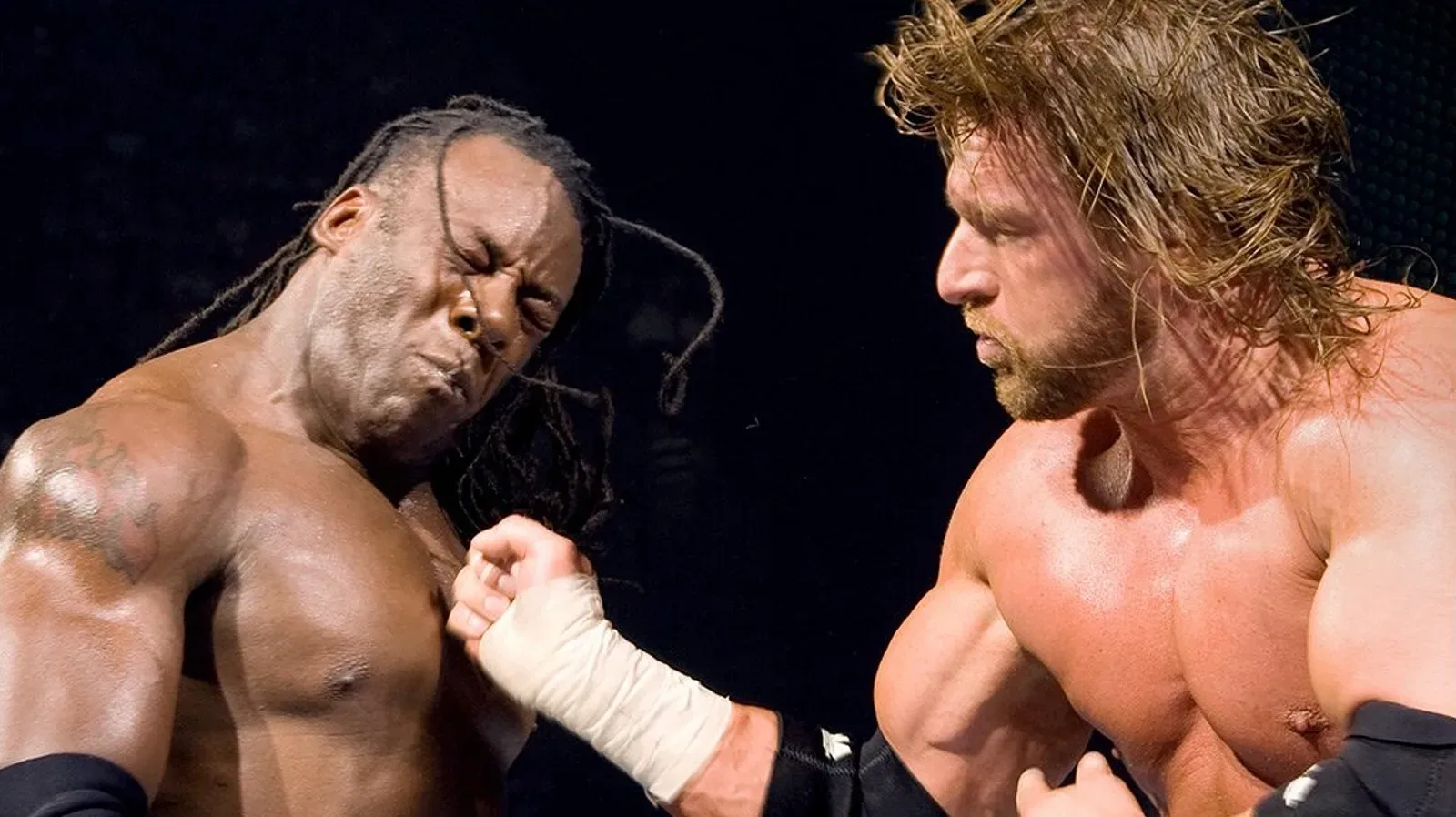
Booker T has revisited one of the most discussed decisions of his WWE career, acknowledging that he would consider changing the finish of his WrestleMania 19 match against Triple H.
The former WCW star challenged Triple H for the World Heavyweight Championship at WrestleMania 19 in a rivalry that has remained a major point of debate for WWE fans. Booker entered the program as the babyface challenger, while Triple H was positioned as the heel champion. The direction of the story, including racial undertones in the buildup, led many viewers to believe Booker should have won the championship on the grandest stage.
Instead, Triple H retained. The match has consequently occupied an unusual place in WrestleMania history: it is remembered not just for the in-ring meeting between two decorated performers, but for the lingering questions around what a Booker T victory could have meant for the storyline and for his WWE legacy.
During an appearance on INSIGHT with Chris Van Vliet, Booker made clear that he generally has not approached his career through the lens of second-guessing finishes. Yet he identified the WrestleMania 19 outcome as a rare exception.
For more background on this topic, read Drew McIntyre Added To Voice Cast For Disney Animated Film ‘Hexed’.
“That would be the only match in my career, that I can honestly say, maybe, if I could change that finish, ... I would change it,” Booker said on INSIGHT with Chris Van Vliet.
That is a notable shift in emphasis from Booker’s previous discussions of the feud. He has repeatedly said he did not have a problem with the match, the promotional segments, or the ultimate result at the time. Booker has also defended the quality of the bout itself, stressing that he and Triple H delivered a strong WrestleMania match regardless of the backlash that followed.
His latest comments do not erase that perspective. Rather, they add a layer of reflection from someone looking back on an important moment after years of hearing how strongly fans felt about it. Booker did not present the issue as a complaint about Triple H, nor did he suggest he was campaigning behind the scenes for a different decision. He said there was never a discussion about him winning the match.
A WrestleMania Goal Reached, But Not the Ending Fans Expected
For Booker, the match represented the fulfillment of a dream even without the title change. He explained that, when he first entered the wrestling business, his ambition was to make it to a WrestleMania main event. Reaching that level was significant, even if the closing thought afterward was that he should have wished to win as well.
“I know so many people wanted me to win, and I love those people for it,” Booker said. “When I got in the business, I said, ... ‘Man, I hope I’m in the main event at WrestleMania one day.’ ... And then I got in the main event, and I didn’t win, I go, ‘Man, I should’ve wished I would’ve won!’”
There is an important distinction in that reflection. Booker’s match with Triple H was for the World Heavyweight Championship and unquestionably carried top-level stakes, but it did not close WrestleMania 19. It took place in the middle of the card rather than in the night’s final slot. Still, from Booker’s viewpoint, being involved in a featured WrestleMania championship program represented an arrival at the level he had hoped to reach.
That framing also helps explain why Booker has often resisted reducing the entire experience to the finish. The opportunity was enormous. He entered WWE after becoming one of WCW’s defining stars and after building a résumé that included extensive championship success. A WrestleMania world-title match against Triple H was a spotlight few performers receive.
At the same time, the contrast between reaching that spot and losing the match is precisely why the result has endured as a talking point. Fans were not merely evaluating a single win or loss in isolation. They were responding to the complete presentation of the rivalry, the themes introduced in the buildup, and the apparent payoff that seemed available if Booker overcame the champion.
Booker T Says He Stayed Away From Backstage Politics
Booker also stressed that he did not enter matches with the expectation that he should be the winner. He said he did not involve himself in backstage politics, a point that is central to how he has described his career. Rather than portraying himself as someone who pushed for outcomes, he said he focused on doing the work and accepting the role he was given.
That approach makes his willingness to name this one finish especially revealing. Booker did not claim that he was denied a promised victory or say that he tried unsuccessfully to change the plan. His point was more personal and retrospective: if he had the ability to revise one result, WrestleMania 19 is the one he would at least consider changing.
The wording matters because it is not an absolute rewriting of history. Booker used “maybe” when discussing the possibility. He remains measured about a story that has prompted very strong reactions for more than two decades. Rather than turning the conversation into an accusation or trying to assign responsibility, he acknowledged the understandable fan sentiment while explaining how he viewed it as a performer.
That measured response is consistent with the way Booker has spoken about the program over the years. He has maintained that the match was good and that the angle was a significant story. His current comments suggest that a compelling story and a satisfying conclusion are not necessarily the same thing. In hindsight, Booker can appreciate the scale and reality of the material while also recognizing why the ending continues to frustrate viewers.
Why the Match Remains a WWE Flashpoint
The discussion around Triple H versus Booker T has never been limited to whether a challenger lost a championship match. WrestleMania is built around major moments, and title victories at the event can permanently shape the perception of a performer. For many fans, Booker winning the World Heavyweight Championship would have been a defining coronation: a popular, accomplished babyface overcoming an antagonist after a feud with deeply uncomfortable elements.
When that did not happen, the finish became inseparable from the rest of the rivalry. Booker’s latest comments validate, at least in part, the emotional investment of supporters who wanted a different payoff. He said he loves the people who wanted him to win, an acknowledgment that their response was not forgotten or dismissed.
He also said that the story was great while recognizing that most people would not fully understand how real it was to him. That observation is significant. Fans can debate booking decisions from the outside, but Booker lived the experience as the person performing the material in front of a massive WrestleMania audience. His view does not have to match every fan interpretation for it to carry unique weight.
Professional wrestling frequently invites audiences to revisit alternate outcomes. A single decision can change the trajectory of a title reign, a character, or a performer’s standing in company history. Yet only a small number of matches become lasting examples of a finish that remains contested long after the event. Booker T versus Triple H is one of those examples because the debate involves both the booking of the championship and the wider implications of the narrative.
Booker’s comments will likely keep that debate active, but they also provide a more nuanced way to view the situation. He is not disowning the match. He is not saying its value disappears because Triple H retained the title. He is instead identifying a finish that, given the chance to revisit it, might have been handled differently.
For a wrestler who says he never built his approach around demanding victories, that admission stands out. WrestleMania 19 remains a major milestone in Booker T’s career, but it is also the rare chapter where he can look back and imagine another ending—one that many fans have pictured for years.
In pictures

Darryl Polo
Darryl Polo is a passionate wrestling fan covering WWE, AEW, TNA and beyond. He loves great rivalries, breakout stars and the moments that keep fans talking long after the bell. How we work.