
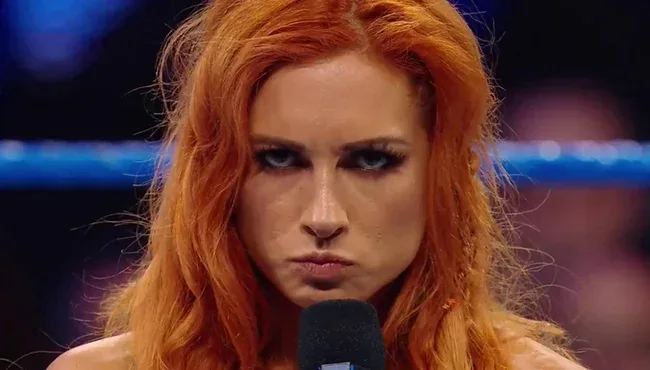
Becky Lynch has offered a candid look back at the emotional foundation behind “The Man,” explaining that the anger audiences saw during the rise of the persona was rooted in a genuine feeling that she had been passed over too many times.
Speaking on No-Contest Wrestling from The Rich Eisen Show, Lynch revisited the period that followed SummerSlam 2018, when one of WWE’s defining modern characters began to emerge. While the presentation became sharper, more confrontational and increasingly ruthless on television, Lynch said the underlying frustration was not manufactured simply for storyline purposes. It came from believing she was continually on the verge of a major opportunity, only to see someone else selected for it.
“The Man” ultimately became synonymous with Lynch’s insistence that she belonged at the very top of WWE. Yet Lynch’s recent comments add important perspective to why the character connected so quickly. Rather than playing a conventional villain after a single storyline decision, she was channeling an ambition and resentment that she says had been building over time.
SummerSlam 2018 Changed the Direction of Becky Lynch
The shift began at SummerSlam 2018, where Lynch challenged Carmella and Charlotte Flair for the SmackDown Women’s Championship. Flair won the match, and Lynch attacked her afterward. WWE initially framed that post-match attack as a heel turn, positioning Lynch as the aggressor in the rivalry with Flair.
The crowd response, however, did not follow the expected script. Fans began cheering Lynch, embracing the edge and defiance she brought to the moment. The reaction created room for the character to develop in a different direction. Instead of settling into a traditional antagonist role, Lynch leaned into the audience’s support while becoming more forceful in her words and actions.
That evolution produced “The Man,” a persona defined by self-belief, confrontation and the refusal to wait politely for validation. The character’s central message was simple: Lynch was done accepting a secondary position. She intended to identify herself as great and demand that everyone else acknowledge it.
In discussing how it began, Lynch made clear that this was not merely a matter of finding a catchphrase or changing her on-screen attitude. She had become tired of repeatedly approaching major moments without being entrusted with the top role.
“It was one of those things where I was just sick of taking a backseat, and that was kind of real. That angst was real,” Lynch said.
Her description speaks to the tension at the center of the character. Lynch was not presenting a complaint as a weakness. She transformed it into a declaration. The persona treated every perceived slight, missed chance and delayed opportunity as evidence that she needed to take control of her own standing.
Feeling Close Was Not the Same as Being Chosen
Lynch said the most difficult part of that stretch was the recurring experience of nearly receiving a larger opportunity but not quite becoming the performer selected to carry the division. In her view, the frustration was not about one isolated decision. It was about the cumulative feeling of being close enough to see the position she wanted, without being the person handed responsibility for it.
“It was like always almost getting the shot and then never being the one that was picked,” Lynch said, describing the feeling of not being the person WWE would identify as its central women’s star and tell to “run with it.”
That distinction is significant in the story of “The Man.” The persona did not argue that Lynch deserved to be included. It argued that inclusion was no longer enough. Her character demanded to be viewed as the leading figure rather than a talented name waiting in the wings for a turn.
It also helps explain why the audience embraced her despite WWE’s initial attempt to frame the attack on Flair as villainous. Wrestling audiences often respond strongly when they believe a performer’s emotion has a recognizable truth behind it. Lynch’s presentation was heightened for television, but the feeling she described—being talented, prepared and still not chosen—is one many viewers could understand.
As the crowd support grew, the tension between intended alignment and actual audience reaction became part of the momentum. Lynch’s refusal to soften her position did not push fans away. Instead, it reinforced the idea that she was finally speaking with the authority and urgency they wanted to see from her.
A Character Built on Ruthlessness and Self-Assertion
The version of Lynch that emerged after SummerSlam was more aggressive than the performer audiences had previously known. She made conflict personal, projected certainty in her own status and treated opposition as proof that others were threatened by her ascent. “The Man” was deliberately uncompromising, and Lynch has acknowledged that she took that approach seriously when it came to selling the conflicts around her.
Her comments now show that she sees a line between serving a wrestling story and the way some of her words landed. Lynch said she has regrets about aspects of the character’s more cutting approach, specifically recalling that she said things she now considers mean.
“Sometimes, I did things that, to be honest with you, I regret. I said a lot of mean things,” Lynch said.
Lynch explained that she justified those remarks as part of making the conflict feel meaningful. In professional wrestling, performers regularly use pointed verbal exchanges to establish stakes and give rivalries emotional clarity. Lynch’s reflection does not deny that purpose. Instead, it recognizes that there can be a personal cost when a character’s voice is built around confrontation.
That self-assessment adds another layer to the legacy of “The Man.” The persona was successful because it was clear, forceful and emotionally legible. But Lynch is not presenting every choice made within that character as beyond reconsideration. She can appreciate the truth that powered it while also acknowledging that not every expression of that truth is something she would now endorse.
The Central Message Remains Unchanged
Even while expressing regret over some of the harsher language, Lynch did not retreat from the conviction that defined “The Man.” Her larger point was that she reached a moment when waiting had become unacceptable. She was no longer prepared to remain seated while others determined whether she was ready for greatness.
“I’m not sitting around anymore,” Lynch said. “I am great, and I am going to claim my greatness.”
That statement captures the lasting appeal of the character more effectively than any label of hero or villain. “The Man” was a response to limitation. Lynch took a feeling of being overlooked and turned it into a public demand for recognition. The character was not built around asking for permission. It was built around declaring that permission was unnecessary.
There is also a difference between claiming greatness and claiming perfection, and Lynch’s reflection illustrates it. She remains firm in her belief that she deserved more than a backseat role. At the same time, she is willing to look back at certain choices and say that she would handle elements differently. That combination of confidence and accountability gives her comments a measured tone.
For WWE, the story remains a reminder that the most resonant transformations can arise when a performer finds a way to make real emotion visible within the framework of a storyline. The SummerSlam 2018 attack on Flair was intended to send Lynch down one path. Audience reaction and Lynch’s own commitment to the underlying feeling helped take the character somewhere else entirely.
Lynch’s reflections do not change the key facts of that rise: she challenged for the SmackDown Women’s Championship, attacked Flair after Flair’s victory, and became increasingly aggressive as fans rallied behind her. What they do provide is a more personal explanation for the intensity that made the persona work.
For Lynch, “The Man” was born from the frustration of coming close and being overlooked. It became a declaration that she would no longer accept that role. Years later, she can still stand behind the desire to claim her place while acknowledging that the path she took sometimes included words she regrets.
Keep reading on SmackDownOnYou
Darryl Polo
Darryl Polo is a passionate wrestling fan covering WWE, AEW, TNA and beyond. He loves great rivalries, breakout stars and the moments that keep fans talking long after the bell. How we work.