
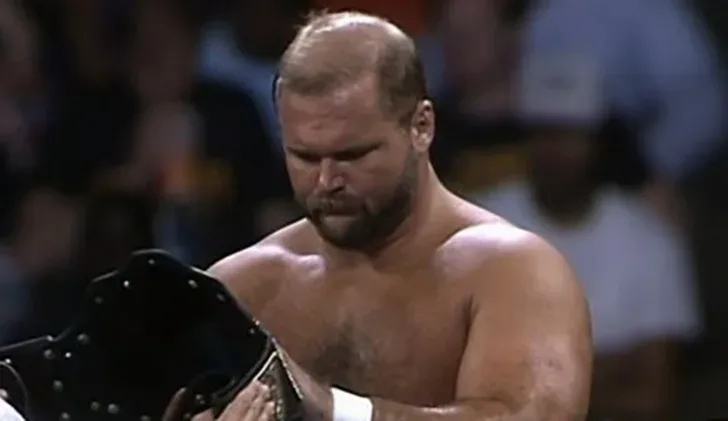
Arn Anderson has offered a blunt assessment of creative control in WCW, arguing that the ability to refuse a match finish was never a privilege available to most of the locker room.
During a discussion of WCW’s March 1997 landscape on ARN, Anderson addressed the story surrounding Scott Hall, Roddy Piper and Hulk Hogan ahead of SuperBrawl VII. The conversation centered on Hall’s recollection of confronting Piper at a bar because Piper did not want to return the favor from their earlier encounter by taking a loss to Hogan.
For Anderson, the episode illustrates a larger reality about power in professional wrestling during that period. While performers could have opinions on their creative direction, only a very small number possessed the kind of standing that would allow them to openly reject an assigned outcome without immediately putting their jobs at risk.
“That thing with Hogan and Piper, there’s only a couple of people could have got away with that,” Anderson said on ARN. “Bischoff was the boss obviously, at the time. If I would have said, ‘I’m not putting Hogan over, I’m not going to put Piper over,’ they’d have said, ‘Fine, get your bag, you’re fired.’ And anybody else, virtually. Only a couple of people.”
For more background on this topic, read Masha Slamovich Reportedly Signed With MLW Before Fightland Title Victory.
Anderson’s point was not simply that WCW had a hierarchy, as every major wrestling company does. It was that the difference between being able to voice concern and being able to actually stop a finish from happening was enormous. A wrestler lower on the card, or even an established veteran without exceptional contractual leverage, could object to a decision. That did not mean management had to change it.
In the situation being discussed, Hogan and Piper were not ordinary names on the WCW roster. Both arrived with enormous reputations, mainstream recognition and a level of importance to the promotion’s presentation that separated them from nearly everyone else. Anderson’s view is that scenarios involving stars of that magnitude cannot be treated as a representation of how the average WCW wrestler could operate.
What creative leverage meant in WCW
Creative control is often discussed broadly in wrestling, sometimes as if it means a talent can simply choose every opponent, finish and story beat. Anderson’s comments present a much narrower and more practical view. He described it as a safeguard available to a limited group of people when they believed they should not be required to do something.
“That’s where that creative liberty comes in,” Anderson said. “That’s your safety net for anything that you don’t feel like you should do. I wish that would have never came up.”
The distinction matters because a booked finish is more than a single result. In wrestling, wins and losses can affect a performer’s momentum, perceived position, future programs and relationship with the audience. A talent who has the contractual or political ability to challenge an outcome may be protecting those interests. But the same arrangement can also make it harder for a promotion to execute long-term plans when major decisions require negotiation with individual stars.
Anderson made clear that he did not see this type of power as a positive for the wrestling business. Asked directly whether creative control was good for the industry, he answered without qualification.
“I think the business would have been just fine without ever doing it,” Anderson said.
That answer reflects Anderson’s longstanding perspective as someone who worked extensively in the ring and behind the scenes. His comments do not deny that performers may have legitimate reservations about particular ideas. Instead, he is questioning whether formalized creative veto power is healthy for the overall structure of a wrestling company.
The Hogan-Piper backdrop
The discussion took place while looking back at March 1997, a pivotal time for WCW. Hogan and Piper had already been involved in a major rivalry, with their collision at Starrcade 1996 standing as one of the defining events in the company’s battle with the New World Order. Their issues continued into the early part of 1997, including the build toward SuperBrawl VII.
Scott Hall’s account, as discussed on the podcast, involved Piper being called out before SuperBrawl over his reluctance to lose to Hogan. Anderson did not present the moment as something that could have been replicated by just anyone in the company. His central argument was that the names involved were precisely why the disagreement could become a subject of negotiation rather than a simple order from management.
Eric Bischoff was WCW’s boss at the time, as Anderson noted. Under a conventional talent-management dynamic, a wrestler refusing a finish could face severe consequences. Anderson used himself as the example: if he had declared that he would not lose to either Hogan or Piper, he believes the response would have been immediate and decisive.
That hypothetical is central to the issue. Anderson was one of the most respected wrestlers in the business, with a major body of work and deep experience in WCW. Even so, he said he would not have had the leverage to take the same stance. That, in his view, demonstrates just how exclusive that level of influence was.
Why finishes remain a sensitive subject
Professional wrestling depends on cooperation. The performers must work together physically, the creative side must establish a direction, and promoters must balance short-term attraction against long-term planning. The agreed-upon finish is where all of those responsibilities meet.
Because results are predetermined, fans sometimes assume that changing a finish should be simple. In reality, it can have consequences far beyond one match. A loss may conclude a rivalry, launch another wrestler, support a championship plan or reinforce a character’s identity. When a key performer can reject a result, the company may need to rebuild an entire plan around that decision.
Anderson’s criticism is rooted in the potential for that process to become uneven. If only a handful of stars can protect themselves from a loss, the creative environment is no longer the same for everyone. The talent with the most leverage can have an additional layer of security that others do not possess.
That does not necessarily mean every dispute over a finish is unreasonable. Anderson specifically framed creative liberty as a “safety net” for something a performer does not believe they should do. But his broader conclusion is that the industry did not require the concept in order to function effectively.
Anderson’s bottom-line view
Anderson’s remarks provide a concise answer to one of wrestling’s most persistent debates: who truly has the ability to say no? In his estimation, it is not the veteran who is respected but replaceable, and it is not the wrestler who simply feels strongly about their booking. It is the rare performer with enough value and leverage to force a conversation.
In the WCW example involving Hogan and Piper, Anderson believes the circumstances were exceptional because the individuals were exceptional. He stressed that virtually anyone else who tried to refuse a major finish would have been told to leave.
His larger verdict is equally straightforward. Creative control may offer protection to the few talents who possess it, but Anderson does not believe it was necessary for professional wrestling as a business. From his perspective, the industry would have been better served if that degree of individual creative veto power had never become part of the equation.

Darryl Polo
Darryl Polo is a passionate wrestling fan covering WWE, AEW, TNA and beyond. He loves great rivalries, breakout stars and the moments that keep fans talking long after the bell. How we work.