
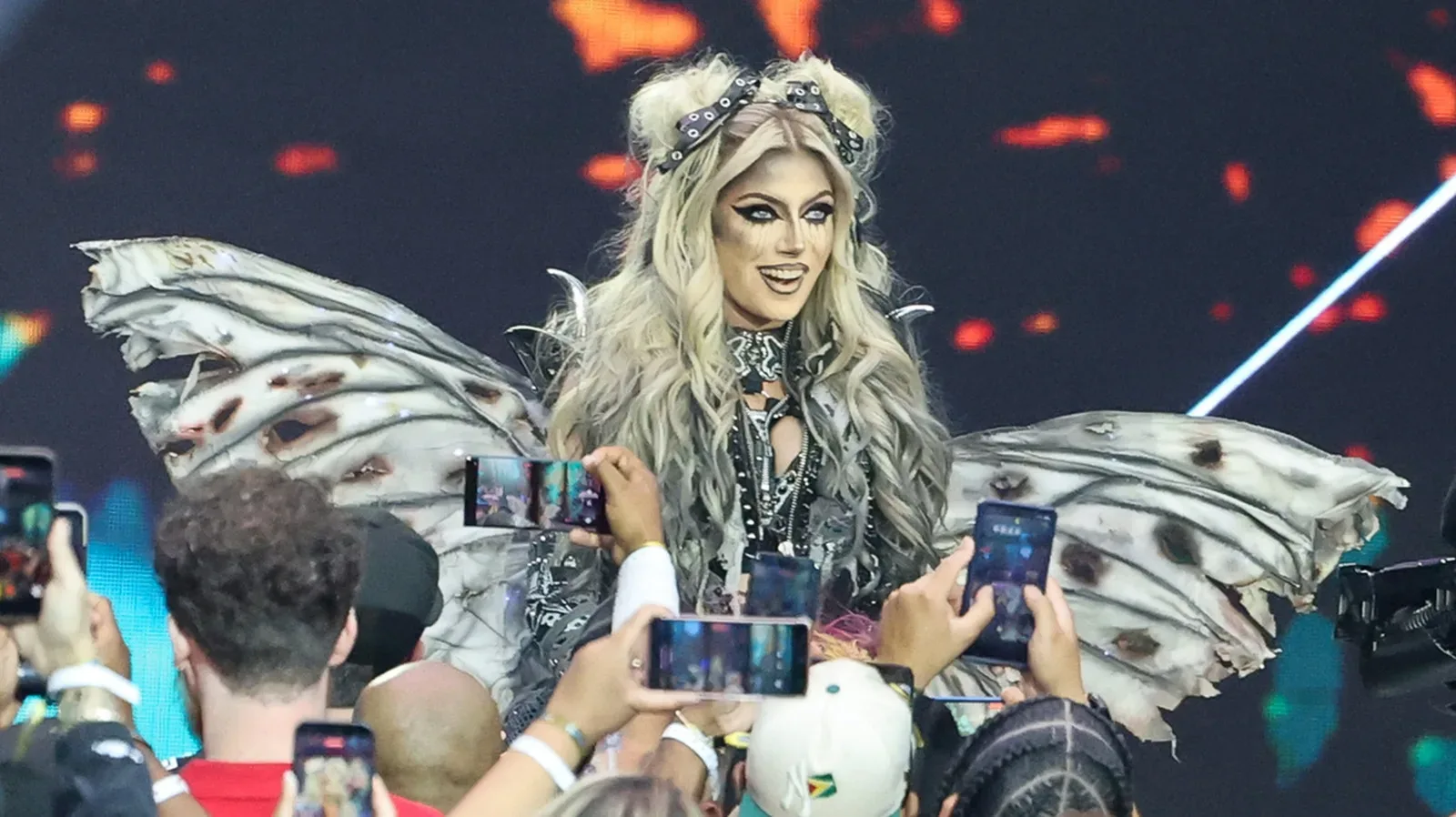
Alexa Bliss has opened up about the emotional experience of taking part in the Bray Wyatt-themed attraction at Universal Studios’ Halloween Horror Nights, describing the opportunity as a deeply personal goodbye to her late former WWE creative partner, Windham Rotunda.
Bliss and Wyatt shared one of WWE’s most distinctive on-screen pairings during the ThunderDome era. After Bliss’ character was drawn into Wyatt’s increasingly unsettling world in 2020, she adopted a darker presentation that connected her to the Firefly Fun House, The Fiend and the psychological horror elements that defined much of Wyatt’s work. Their association became a major part of both performers’ stories until they went their separate ways following WrestleMania 37.
Wyatt, whose real name was Windham Rotunda, died in 2023. In the years since, aspects of his imagination and legacy have continued to be celebrated through WWE’s Wyatt Sicks faction and through the Halloween Horror Nights haunted-house attraction inspired by his work. For Bliss, walking into that environment carried a weight far beyond a typical guest appearance.
Speaking on A Shot of Brandi, Bliss said Wyatt had often talked about wanting to have a haunted house at the annual Universal Studios event. Seeing that ambition ultimately become real was therefore a powerful moment, even though he was not there to experience it himself.
For more background on this topic, read Dave Meltzer Reiterates No WWE Talent Have Pulled Out Of Crown Jewel Travel.
“To see it happen was so cool, but it was so bittersweet knowing that he would never see it,” Bliss said on A Shot of Brandi.
The distinction between celebration and grief was central to Bliss’ recollection. Halloween Horror Nights is designed to immerse visitors in elaborate horror settings, but the Wyatt-themed house offered something more personal for those who worked closely with him. Rather than simply evoking a wrestling character, the attraction represented an idea Wyatt had wanted to bring to life. Bliss explained that her first walk through the house was especially difficult emotionally.
“The first time I walked through, it [felt] like someone hit you in the gut,” Bliss said on A Shot of Brandi.
That reaction speaks to the closeness of the connection between Bliss’ WWE character evolution and Wyatt’s creative world. Their 2020 pairing dramatically changed Bliss’ presentation. She moved away from the bright, playful persona that had made her a multi-time champion and into a more unnerving role marked by doll imagery, shifting moods and the influence of The Fiend’s universe. The material stood apart from much of WWE television at the time because it leaned heavily into atmosphere, character transformation and supernatural horror.
Bliss’ role was not limited to appearing in the attraction as a visitor. She was able to participate as a scare actor for several hours, placing her directly inside the tribute rather than observing it from outside. Her assignment took her back to a setting that was especially associated with her period alongside Wyatt: the Firefly Fun House.
Bliss said she worked in a scene near a television that continuously showed Rotunda. The experience allowed her to revisit the creative space where their WWE story began, but it also made the reality of his death more immediate.
“I got to do the Firefly Funhouse scene, where I was next to the TV that was just playing Windham over and over and it was so cool to be a part of that again, but also so heartbreaking after I did it,” Bliss said on A Shot of Brandi.
The Firefly Fun House was among the key foundations of Wyatt’s later WWE work. Through its surreal characters, children’s-show framing and darker undertones, it gave Wyatt a vehicle for a wide range of storytelling ideas. It also established the world from which The Fiend emerged, eventually leading to the story that brought Bliss into the fold. The haunted-house scene therefore carried a specific significance for Bliss, tying together the beginning of their alliance and the larger creative legacy now being honored.
Bliss revealed that she and Wyatt had hoped to reconnect on screen after the end of their WrestleMania 37 storyline. Those plans never came together. She said her pregnancy and Wyatt becoming ill prevented the planned reunion from happening. The fact that their intended return was never realized added another layer to her appearance at Halloween Horror Nights.
For Bliss, entering the Firefly Fun House portion of the attraction was not just an opportunity to revisit an old WWE role. It became an occasion to confront a loss that still feels immediate. She characterized Universal allowing her to be part of the attraction as an act of generosity and described the moment as a way to say farewell.
“I think that was one of the first times that it hit me that he was actually gone,” Bliss said on A Shot of Brandi. “This is me saying goodbye. This is me going back to where it started and me saying goodbye.”
That sense of returning to the beginning is especially fitting given the unusual arc of Bliss and Wyatt’s WWE partnership. Their pairing was initially unexpected, blending two established performers with very different histories and styles. Bliss had built her career around championship success and sharp character work, while Wyatt had become known for layered concepts and a willingness to push WWE presentation into stranger territory. Together, they created a story that remained visually and tonally different from traditional WWE rivalries.
Wyatt’s creative influence has remained visible after his passing. The Wyatt Sicks has carried forward elements associated with his approach to wrestling storytelling, while the Halloween Horror Nights attraction has offered a separate venue for audiences to engage with the horror imagery and imaginative world-building he valued. Neither development changes the personal loss felt by those close to him, but both demonstrate the reach of ideas that extended beyond a standard WWE character.
Bliss’ comments also underline why the haunted-house experience was so affecting. She was not merely participating in a promotional appearance connected to a former colleague. She was stepping into a physical recreation of a world that had been important to both of them, surrounded by reminders of a planned creative future that never had the chance to unfold.
There is an inherent tension in tributes of this kind. They preserve memories, celebrate artistic accomplishments and introduce the work to new audiences, but they can also make absence more tangible for the people who shared that work firsthand. Bliss’ description of the experience as “cool” and “heartbreaking” captures that contradiction. The attraction reflected a dream Wyatt had expressed, yet it also emphasized that he was unable to see the final result.
For WWE fans, the Firefly Fun House and Bliss’ involvement in its mythology remain memorable parts of a highly unconventional chapter in company history. Her appearance at Halloween Horror Nights added a final, personal dimension to that chapter. By taking her place in the Firefly Fun House scene, Bliss was able to revisit the creative partnership that helped redefine her character while honoring Rotunda in a setting that reflected one of his ambitions.
Her account makes clear that the evening was not easy. Still, it gave Bliss a chance to participate in a tribute she regarded as meaningful and to say goodbye in the place where so much of that shared story began.
In pictures

Darryl Polo
Darryl Polo is a passionate wrestling fan covering WWE, AEW, TNA and beyond. He loves great rivalries, breakout stars and the moments that keep fans talking long after the bell. How we work.