
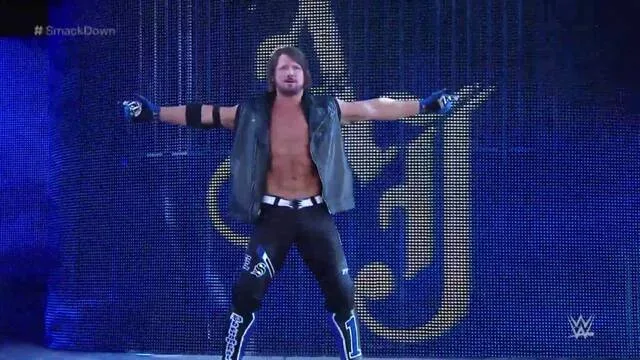
AJ Styles has spent years presenting himself as one of WWE’s defining figures, particularly on SmackDown, where “The house that AJ Styles built” became a familiar declaration of his confidence and standing. But Styles says his first night in WWE was defined by a far different feeling: uncertainty.
Speaking during a recent conversation on Cody Rhodes’ podcast, Styles reflected on arriving for his WWE Royal Rumble debut and trying to find his place in a locker room that was largely unfamiliar to him. The debut has long been remembered as a major moment, but Styles explained that the experience carried the pressure of entering an established environment and wanting to earn the respect of the wrestlers already there.
“Nervous. I mean, I’m in someone else’s house,” Styles said when asked about his mindset. “This is not my house yet. I’m just moving in.”
That contrast is particularly notable given the way Styles would later be positioned in WWE and the way he has positioned himself. The “house” line eventually became a signature part of his presentation on SmackDown, a statement that reflected his accomplishments and his belief that he had become one of the brand’s central stars. On the night of the Royal Rumble, however, Styles did not see himself as someone arriving to take ownership of anything. He saw himself as a newcomer walking into a place that already belonged to others.
For more background on this topic, read Adam Copeland Explains Why AEW Has Opened Doors To Arenas He Could Not Reach In WWE.
A Different Kind of Royal Rumble Surprise
Rhodes noted that Styles’ arrival was handled differently from the type of surprise appearance that has become common in more recent years. Rather than being completely hidden from the rest of the roster, Styles was able to appear at a meeting beforehand. That gave the WWE locker room an opportunity to see him before his Royal Rumble entrance.
For an audience, the debut still carried enormous impact. Styles’ entrance immediately established that a major name had joined WWE. For Styles personally, though, the moment was about more than making an entrance in front of a crowd. It was also about meeting coworkers, reading the room, and understanding whether the people around him viewed him as a welcomed addition.
Styles said that concern weighed on him because many of the wrestlers in WWE did not know him well.
“And so I’m very nervous about how the other guys would feel about me, you know, ’cause they don’t know me,” Styles said.
He acknowledged that there were people in the locker room with whom he already had a connection. Road Dogg was among the names Styles mentioned, and seeing familiar faces provided a sense of comfort during an otherwise unfamiliar transition.
“There’s a lot that didn’t know me,” Styles continued. “And for the some that did, I was so happy to see them, you know, like Road Dogg. You know, there’s just a couple of guys that I was just like, ‘Oh man,’ and kind of latched onto, ’cause I didn’t know anybody that well.”
Respect Was the Central Concern
Styles’ comments were not framed as anxiety over whether he could perform in the ring. Instead, he described a concern rooted in respect. He was arriving at 37 years old, after an established career outside WWE, and he understood that he was entering a company with its own relationships, routines, and locker-room culture.
That distinction matters in the way Styles described the moment. He was not treating WWE as merely another stop. He recognized that he was entering a workplace where other wrestlers had already built their careers, and he wanted them to understand that he did not see himself as separate from the group.
“I didn’t know a lot of guys up there, and I didn’t know how they felt about me,” Styles said. “And I know I’m 37 years old, worried about this, but it’s just a respect thing. Like, I’m coming into your house, dude. I want you guys to know I just want to be part of the team.”
The remarks offer a candid look at the human side of one of WWE’s most celebrated modern debuts. Major arrivals are often remembered through entrances, crowd reactions, and the immediate possibilities created on television. Styles’ recollection emphasizes what happens away from the camera: a veteran performer navigating a new locker room and hoping that the people already inside will understand his intentions.
There is also an irony in the language Styles used. The same wrestler who would later call SmackDown his house initially viewed WWE as someone else’s. The evolution from “I’m just moving in” to “The house that AJ Styles built” reflects the shift in confidence and belonging that can only come after time, experience, and acceptance within a company.
From New Arrival to a SmackDown Calling Card
Styles’ “house” catchphrase has endured well beyond its original use as a boast. It has become closely connected to his WWE identity, especially in relation to SmackDown. The phrase carries the kind of certainty that is expected from a performer who believes he has left a lasting mark on a brand.
It has also become recognizable enough that WWE authority figure Nick Aldis has used it in reference to Styles. That detail underlines how firmly the line has become attached to Styles’ place in the company. What began as a declaration from Styles has become part of the wider language surrounding him.
Yet Styles’ recollection of the Royal Rumble debut gives the phrase additional context. It was not the attitude he brought with him through the door. In his own telling, his initial priority was not claiming the house. It was being accepted in it.
That perspective also speaks to why the locker-room reaction mattered to him. A wrestler can receive a major entrance and a loud response, but joining a new roster means adjusting to a different set of colleagues and earning trust in a new environment. Styles was aware of that reality, even as his debut placed him immediately in a prominent spotlight.
The Lasting Meaning of the Debut
Styles’ WWE Royal Rumble debut remains a landmark moment because it represented the arrival of a performer whose reputation had already been built over many years. The conversation with Rhodes adds another layer to that memory. The confidence seen on screen did not erase the apprehension Styles felt before taking that step.
His comments also show how much he valued the relationships around him. Styles did not describe walking into WWE with the assumption that his past accomplishments would automatically settle every question. He wanted the locker room to know that he respected the space they had created and wanted to contribute as part of the team.
That approach makes the later use of “The house that AJ Styles built” more meaningful. It is a statement that only works because of the journey between those two points: arriving as someone unsure of how he would be received, finding familiar faces to lean on, and eventually becoming so identified with SmackDown that the phrase became inseparable from his WWE persona.
For Styles, the Royal Rumble was not simply the night he appeared in WWE. It was the night he entered a new house, hoped to be welcomed, and began the process of making a place for himself within it.

Darryl Polo
Darryl Polo is a passionate wrestling fan covering WWE, AEW, TNA and beyond. He loves great rivalries, breakout stars and the moments that keep fans talking long after the bell. How we work.