
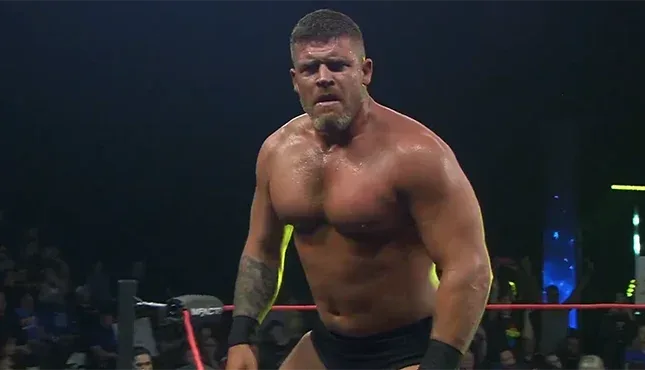
Adam Copeland believes Steve Maclin is the kind of opponent who can bring out a particularly physical side of professional wrestling.
Copeland is scheduled to face Maclin in a first-time-ever singles match at MLP Northern Rising later tonight. The bout brings together a veteran whose career has spanned generations and an opponent who has openly discussed Copeland’s influence on his path into wrestling. For Copeland, however, the appeal was not simply the personal connection that emerged during the build to the match. It was what he saw in Maclin as a performer and the hard-edged style the two could create together.
Speaking about the upcoming encounter, Copeland said Maclin immediately stood out when he looked at the possible names available to him. He praised both Maclin’s work and the story behind his career, while explaining that he was unaware of Maclin’s childhood connection to him at the time he settled on the match.
“In terms of (Steve) Maclin, man, I’ve always appreciated what he brings to the table and his story too,” Copeland said. “And at this stage of my career, I look to who I’m going to wrestle, and when the roll call of opponents (came), I was like, Maclin. I didn’t know any of the other things. I didn’t know that when he played wrestling as he was growing up, when he played as himself, it was my action figure. I didn’t know any of that stuff before I, you know, kind of said, okay, that’s my guy there, you know?”
For more background on this topic, read Pro Wrestling NOAH Unveils Full Card for 2026 N-1 Victory Final.
A Matchup Built on Style Rather Than Familiarity
There is a clear competitive logic to Copeland’s selection of Maclin. Even before learning about Maclin using a Copeland action figure when playing wrestling as a child, Copeland identified a fit based on how Maclin presents himself between the ropes. Maclin has developed a reputation as an intense, forceful wrestler, and Copeland sees the potential for a match that emphasizes rugged exchanges and sustained physicality.
Copeland specifically invoked the feel of classic NWA title matches, describing a form of wrestling built around grit, pressure, and the sense that both competitors are trying to wear the other down rather than merely race from one highlight-reel sequence to another. He compared that desired atmosphere to the work associated with Terry Funk and the Brisco family.
“Cause I really—I love the idea of having that NWA title match, that sweaty grinding, that kind of style that, that Funk/Brisco kind of thing, and I see him and I go, ‘I can do that with that guy,’” Copeland said.
That description establishes an intriguing expectation for Northern Rising. Copeland has worked in many different kinds of matches over the course of his career, from major-event spectacle to deeply personal rivalries and bouts centered on resilience. Maclin, meanwhile, provides a different kind of challenge: a direct, physical opponent whose intensity appears to align with the kind of match Copeland wants at this point in his career.
The fact that this is their first singles meeting adds another layer. There is no long history of previous one-on-one results between the two to dictate the rhythm of the contest. Instead, the match will be shaped by the styles each man brings into the ring and by the mutual understanding that the opportunity carries personal meaning for Maclin.
Maclin’s Childhood Connection Adds Emotional Stakes
Maclin has spoken during the build to MLP Northern Rising about Copeland’s influence on his career. For a wrestler, getting the chance to share a ring with someone who was part of their earliest relationship with the sport can be a unique moment. It can also create a difficult competitive balance. Respect may be genuine, but it has to be set aside once the opening bell rings.
Copeland’s comments suggest that he did not choose Maclin because of that admiration. The personal history was information he learned after the fact. His interest was rooted in Maclin’s current body of work and the possibility of producing a match with a distinct identity.
That distinction matters. Copeland did not frame the bout as a ceremonial meeting between an established star and a wrestler inspired by him. He framed it as a serious matchup with a performer he has long appreciated. By identifying Maclin as “my guy” from the list of possible opponents, Copeland made clear that he views him as a credible opponent capable of matching the tone he wants to set.
For Maclin, the match is therefore both an opportunity and a test. The emotional significance of facing a formative influence may be part of the story, but Copeland’s comments place the focus squarely on what Maclin can deliver in the ring. Maclin has been chosen for a competitive reason, and the expectation is that he will meet that faith with the aggressive, grinding approach Copeland outlined.
Copeland’s Priorities at This Stage of His Career
Copeland’s remarks also offer insight into how he approaches opponents at this stage of his career. Rather than discussing a desire to simply collect new names or revisit familiar matchups, he spoke about looking at who he can wrestle and finding the person who inspires a particular kind of contest.
That approach puts emphasis on chemistry, style, and emotional credibility. Copeland’s reference to classic NWA championship wrestling is especially revealing because it points to matches where selling, pacing, endurance, and toughness are central. Those bouts can contain memorable moves, but the moves are most effective when they grow out of the struggle rather than replace it.
Elsewhere, Copeland has emphasized that moves alone are not the most important part of wrestling and that forming a connection with the audience matters more. His assessment of Maclin fits that philosophy. Copeland is not merely talking about what the two men might execute. He is talking about creating a feeling: a sweaty, hard-fought contest where every exchange contributes to the impression that both wrestlers are being pushed to their limit.
In that sense, Northern Rising has the potential to present a match that is as much about atmosphere as it is about technique. The crowd will know that Maclin once looked up to Copeland. They will also know that Copeland selected Maclin because he saw a wrestler with the tools to create something physical and meaningful. Those threads can make even basic moments—an escape, a strike, a hard landing, a refusal to stay down—carry greater weight.
What to Watch at MLP Northern Rising
The central question entering Copeland vs. Maclin is whether the match develops into the exact kind of battle Copeland has envisioned. His comments leave little doubt about the desired blueprint: a tough, grounded fight with the texture of old-school championship wrestling.
- Physicality: Copeland expects Maclin to bring a rugged style, and he has indicated that he wants to answer it in kind.
- First-time uncertainty: With no prior singles match between them, both men will be working without an established one-on-one template.
- Maclin’s motivation: The chance to face a wrestler who influenced him gives Maclin a major personal incentive, but the match will demand composure as well as emotion.
- Connection with the crowd: Copeland’s broader belief in audience investment over empty spectacle could make the match’s pacing and struggle especially important.
Copeland has already made his evaluation of Maclin clear. He appreciates what Maclin brings to wrestling, values the story behind him, and sees him as a wrestler capable of sharing a specific kind of hard-nosed match. That is substantial praise from someone who has experienced virtually every level of the industry.
MLP Northern Rising will now determine how that confidence translates when they finally meet in singles action. Maclin enters with a rare chance to compete against someone who helped shape his passion for wrestling. Copeland enters having deliberately picked an opponent he believes can help create a gritty, throwback fight. Their first encounter is positioned not as a nostalgia exercise, but as a collision between admiration, opportunity, and two wrestlers prepared to make physical storytelling the priority.

Darryl Polo
Darryl Polo is a passionate wrestling fan covering WWE, AEW, TNA and beyond. He loves great rivalries, breakout stars and the moments that keep fans talking long after the bell. How we work.