
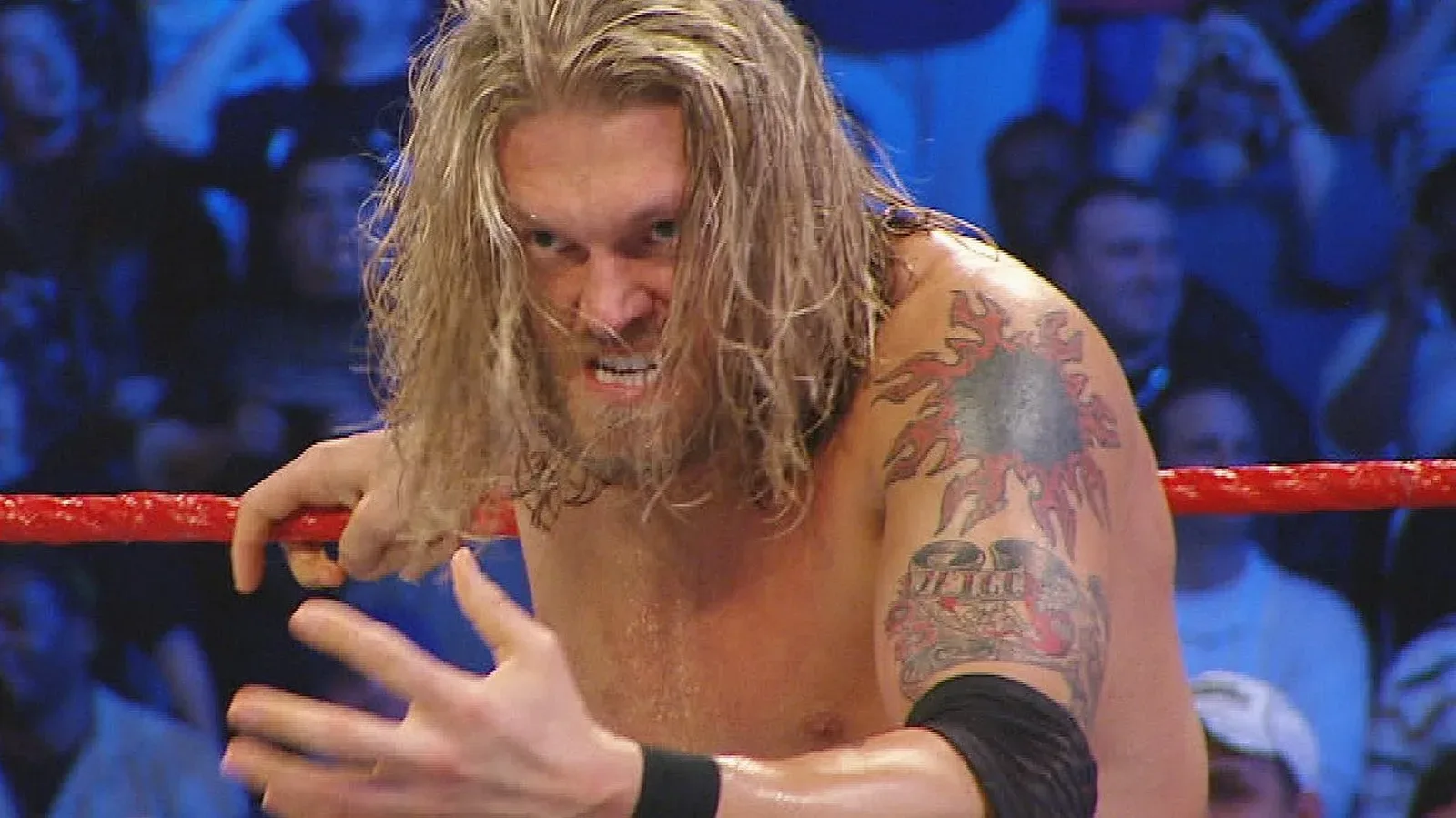
Adam Copeland has spent decades being associated with some of WWE’s most visually spectacular moments, from ladder matches with Christian Cage to championship-winning Spears and high-profile returns. But when looking back at the period that helped turn him from an acclaimed tag team and singles performer into a true main-event level attraction, Copeland pointed to his emotionally charged feud with Matt Hardy.
Speaking with Daily Faceoff, Copeland explained that the Hardy program was a major turning point in the way he viewed his responsibilities as a performer. It was not simply about producing a strong match or executing a memorable move. Instead, he began thinking more carefully about pacing, camera placement, emotional beats and how individual moments could stay with an audience long after a show ended.
“[That was] when I started to put together what exactly was going to move me beyond where I was at, and that was taking my time and making sure that, that camera could get that shot,” Copeland said.
The rivalry with Hardy arrived during an important transition in Copeland’s WWE career. He had already achieved enormous success as Edge alongside Christian, with the pair becoming one of the defining tag teams of their generation. Their matches against The Hardy Boyz and The Dudley Boyz helped redefine the scale of WWE’s tag team division, particularly through the groundbreaking Tables, Ladders and Chairs match at SummerSlam 2000.
For more background on this topic, read Tommaso Ciampa Defeats Charles Mason at HOG Salvation After Memorable Face-Off.
That match established a template for chaos, innovation and spectacle that would become closely linked to all six competitors. Copeland, however, eventually needed to establish a clearer singles identity. The Edge character’s ascent required more than the athleticism and daring audiences had come to expect from the TLC era. It required a presentation that made every major decision, expression and physical confrontation feel significant.
A Feud Built Around Emotion Rather Than Moves
The Edge-Matt Hardy issue was notably different from the kind of rivalries that had made Copeland famous. Its foundation was intensely personal, and the storyline carried a level of raw emotional investment that made fans react in ways that were distinct from a conventional competitive feud. The program demanded that both wrestlers communicate the gravity of the situation beyond the ring.
For Copeland, that experience reinforced the importance of allowing a scene to breathe. A pause at the right time, a look toward the camera or the decision to wait for the crowd response could be just as essential as a high-impact maneuver. It was a lesson in making television wrestling feel cinematic without losing the immediacy of a live event.
Copeland said the shift involved working with production personnel while adopting a broader perspective on how wrestling was presented. “Now I’m thinking of shots, because shots become moments, and moments are what actually stay and resonate with an audience,” he said.
That philosophy is easy to trace through the rest of his career. Edge developed into a wrestler whose biggest matches often featured highly recognizable imagery: the sudden burst of a Spear, an intense stare before an attack, the use of the Money in the Bank briefcase, or the visual of a championship celebration after a major victory. Those elements gave audiences simple but powerful memories to associate with the character.
Copeland contrasted that style of presentation with an approach centered entirely on increasingly difficult offense. He acknowledged the value of spectacular moves, but stressed that a move has its greatest value when it supports a larger feeling or image. “They don’t remember, ‘Oh, there was that Poison-Rana.’ No. They may remember a Spear off a ladder because of the spectacle of it, and the flashbulbs in the background when there was still cameras – disposable cameras – but to me, it’s moves are great, but it’s all about making connection,” he said.
From Tag Team Standout to ‘Rated R Superstar’
Copeland’s comments offer insight into why the Edge persona became such an effective main-event character. His early career earned him credibility through physical risk and tag team excellence. The later version of Edge relied heavily on manipulation, opportunism, confidence and emotional reactions from the crowd. The character could be hated for his actions, but he was difficult to ignore because viewers understood what they were meant to feel in response to him.
The program with Hardy helped emphasize that distinction. It showed that Copeland could carry material driven by character conflict, rather than being defined solely by the match stipulations that had elevated him earlier in his career. That ability became vital as he entered the WWE Championship picture and established himself as one of the company’s most prominent villains.
His eventual status as “The Rated R Superstar” was built on more than one feud, of course. Copeland’s career included rivalries and partnerships with major names across multiple generations, and he continued evolving through championship reigns, retirement, an unexpected return to the ring and a new chapter outside WWE. Yet his reflection on the Hardy feud identifies the point at which his creative approach became more deliberate.
Rather than treating each match as a collection of moves, Copeland began treating the entire presentation as a means of delivering a lasting message to the audience. That meant understanding where the cameras were, when the commentators and crowd needed time to absorb an angle, and which image would best communicate the stakes of the story.
The Difference Between Applause and Connection
Copeland also discussed the difference between a crowd approving of what it sees and an audience truly investing in a wrestler. In his view, broad reactions to a match can be positive, but they do not necessarily mean the fans have formed a durable attachment to the people involved.
He said he would prefer fans chanting his name over chanting the name of the promotion, because a chant aimed directly at the wrestler demonstrates that the performer has reached the audience on a more personal level. Copeland also took issue with generic chants such as “This Is Awesome,” arguing that while such a response recognizes an entertaining performance, it does not automatically reflect an emotional bond between the audience and the talent.
“When you truly start to make strides, and when you truly start to get ‘over,’ is when they connect to you,” Copeland concluded.
It is a perspective shaped by a wrestler who has experienced nearly every kind of crowd response. Copeland has worked in tag team spectacles, singles main events, comedy segments, championship rivalries and deeply personal programs. He has performed before audiences eager for inventive action and crowds that were reacting to the emotional consequences of a long-running story.
His point is also relevant to the modern wrestling environment, where performers can generate instant attention through highlight clips and dramatic moments but must still find ways to build a relationship with viewers over time. Spectacle can create a reaction, but character and storytelling are what give that reaction a longer lifespan.
Why the Lesson Still Matters
The Matt Hardy feud remains a notable chapter in Copeland’s evolution because it pushed him to think beyond the ring in a more complete way. He did not abandon the physical intensity that made Edge a star. Instead, he learned how to place that intensity within a larger framework of storytelling and presentation.
That mindset helped create the version of Edge that rose into WWE’s top tier: a performer who understood the importance of timing, who knew how to make a single visual register with viewers and who valued emotional investment over applause for its own sake. The biggest moments of his career were not memorable merely because of what he did physically. They endured because audiences understood why those moments mattered.
For Copeland, the feud with Hardy was therefore more than a controversial or heated rivalry from a particular WWE era. It was a creative education. It taught him that the most effective wrestling moments are not always the busiest ones, and that the path to genuine main-event status comes from making fans feel connected to the person at the center of the story.
In pictures

Darryl Polo
Darryl Polo is a passionate wrestling fan covering WWE, AEW, TNA and beyond. He loves great rivalries, breakout stars and the moments that keep fans talking long after the bell. How we work.