
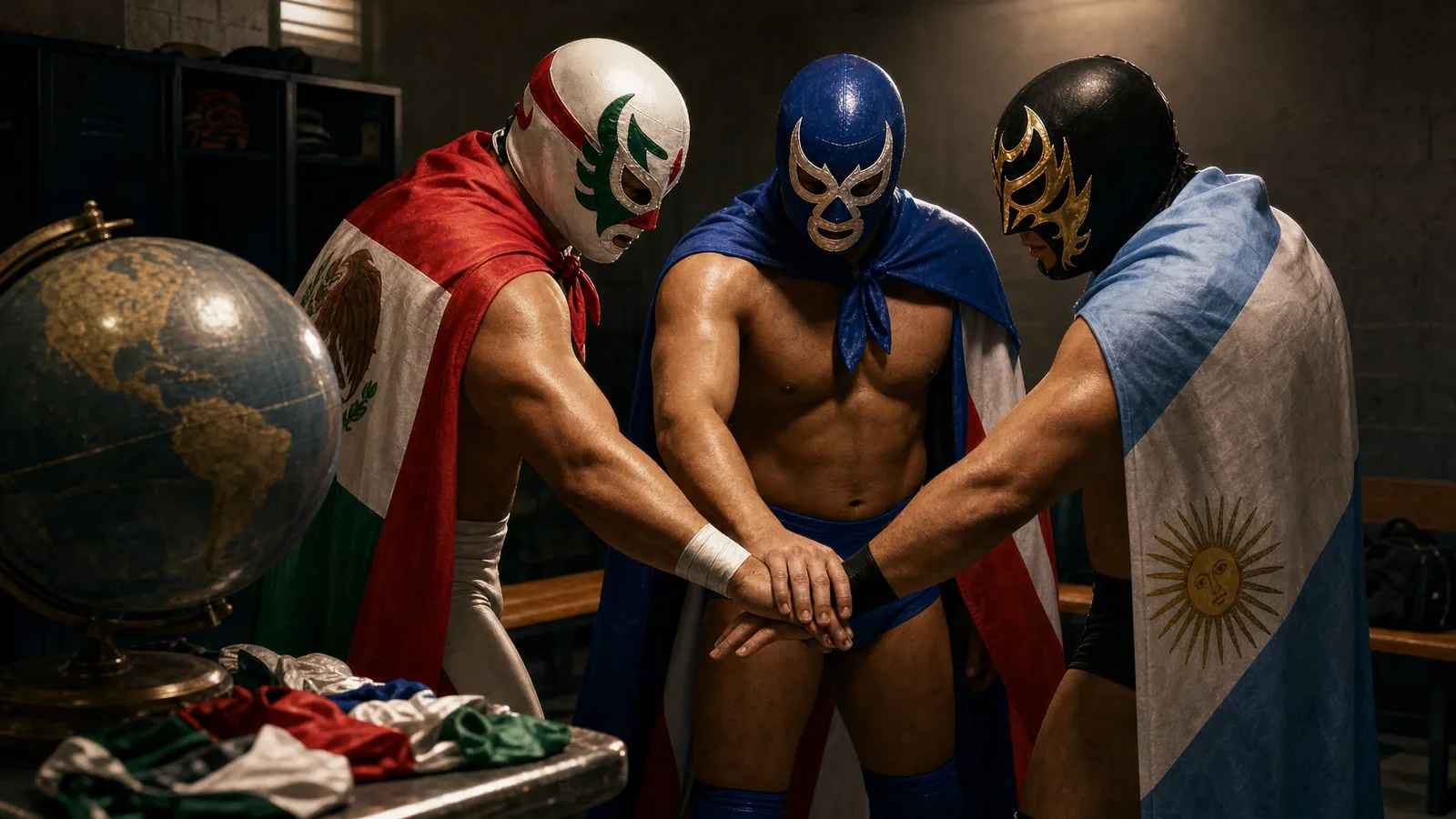
A tournament built around trios
The documented 2015 AAA Lucha Libre World Cup was a completed tournament built around trios: every listed first-round side had three wrestlers. Its winning Dream Team brought together Rey Mysterio, Myzteziz and Alberto El Patrón. That starting point matters when reading the event’s team names. The World Cup was not simply a series of individual international matches placed under one banner. Its basic competitive unit was a three-person side, so the identity attached to a team applied to a group whose members had to advance together through the tournament.
For viewers, the trios foundation provides a useful distinction between the tournament’s sporting structure and its presentation. The structure was a bracket of three-wrestler teams. The presentation, however, was far less uniform: some sides were named for countries, some for promotions, some for a broader region, some for Mexican legends and some as Dream Teams. Rather than treating every label as a statement of the same kind, it is more accurate to ask what identity each particular team name foregrounded in that round and edition.
The 2015 field was not a strict nations-only cup
The 2015 bracket makes the flexible approach especially plain. Its labels included Team USA, Team AAA, Team NOAH, Team AJPW, Team TNA/Lucha Underground, Team Rest of the World, Team Mexleyendas and a Dream Team. A viewer could therefore encounter a country-style label alongside an AAA side, two Japanese promotion identities, a joint TNA/Lucha Underground banner, a broad international category and a specially named all-star grouping. The shared tournament setting connected these unlike labels without making them interchangeable.
Team USA’s match with Team AAA shows how a national label could frame competition against the host promotion’s own representatives. Moose, Cage and ACH represented Team USA, while El Hijo del Fantasma, Psycho Clown and El Texano Jr. represented AAA; Team USA won that match. This pairing is a useful reminder that “World Cup” did not require the field to be organized exclusively as one country versus another. In this documented match, the visible contrast was a U.S.-named side against a side explicitly named for AAA.
Other 2015 names sharpen the point. Team AJPW consisted of Tiger Mask III, Masamune and Kenzo Suzuki, while Team NOAH appeared separately, making Japanese promotion identity visible in two different places in the bracket. Team TNA/Lucha Underground grouped Matt Hardy, Mr. Anderson and Johnny Mundo under two promotion names. Team Rest of the World, featuring Drew Galloway, El Mesias and Angelico, supplied a broad international grouping rather than a single-country designation. The labels gave the bracket several ways to organize outside representation.
Mexleyendas added another category. Blue Demon Jr., El Solar and Dr. Wagner Jr. were grouped as Team Mexleyendas, a Mexican-legends label rather than simply Team Mexico. The eventual winners were likewise a Dream Team, not a Team Mexico entry. Those choices make a simple reading of the 2015 event as a nationality tournament incomplete. National framing existed, but it sat beside labels based on promotion affiliation, a legends designation and a chosen star combination.
How trios draws could become singles decisions
The 2015 final showed that a trios contest did not always end through an immediate three-on-three decision. The Dream Team and Team TNA/Lucha Underground first reached a time-limit draw. Myzteziz then faced Mr. Anderson, and Matt Hardy faced Alberto El Patrón; both singles matches also reached time-limit draws. Rey Mysterio subsequently defeated Johnny Mundo to award the World Cup to the Dream Team. The decisive moment was therefore a representative singles bout following unresolved team competition.
The third-place process that year followed a comparable pattern after a team-level deadlock. ACH and Blue Demon Jr. wrestled to a draw, after which Cage defeated Dr. Wagner Jr. to secure third place for Team USA. This is important for following the tournament on its own terms: a team’s standing could depend on selected members after the trios stage had not settled the result. The format retained the team as the entry and recipient of the placing while allowing individuals to carry the final decision.
A practical viewing question is therefore: when the match changes from trios to singles, what has stayed the same? The answer in these documented examples is the team contest and its consequence. The individuals change, but the win is assigned to the side they represent. That creates two connected levels to watch: how the trio performs before the deadlock, and which wrestler is selected when a representative fall is needed. It is a structural variation within this World Cup setting, not evidence of a general rule for lucha libre.
The 2016 sudden-death procedure made selection explicit
The 2016 Night One report describes the mechanism more formally. Matches had roughly 15 minutes, and sides without a winner in that span entered sudden death. Each team selected one wrestler for a singles match, the clock reset to five minutes, and additional five-minute singles rounds could follow until a pinfall or submission produced a winner. The procedure gave the tournament a defined route from an undecided trios match to an individual deciding fall.
AAA/Mexico versus Japan Oudou/Zero One demonstrates the procedure in action. Pentagon Jr., Texano Jr. and Psycho Clown formed the AAA/Mexico side. After the trios match did not settle the contest, Pentagon Jr. and Masato Tanaka were selected for a sudden-death round that expired. A second round selected Ikuto Hidaka and Texano Jr., with Texano winning the deciding fall. The label itself also paired a country name and an organizational identity, rather than choosing one category over the other.
Another 2016 match needed three sudden-death selections. Team Internacional of Mexico, made up of Rey Mysterio Jr., Dragon Azteca Jr. and Dr. Wagner, faced Team TNA/USA of Tyrus, EC3 and Eli Drake. Dragon Azteca Jr. pinned Tyrus in the third sudden-death selection. For a viewer, this format means a trios result can become a small sequence of selection decisions and brief singles contests, while the team labels remain the organizing frame of the match.
The available 2016 evidence also sets a needed boundary. The sudden-death format is documented for that edition, and it preserved team selection and team advancement while letting one wrestler resolve an undecided trios match. It should not be described as a universal lucha libre rule, nor should it automatically be projected onto every World Cup edition. The reports support a clear description of this event-specific procedure; they do not establish that the same rule governed all similar tournaments.
National identity and promotion identity could overlap
The 2016 card repeatedly used hybrid names. Team Japan PWW/Oz Academy faced Team Canada AAA/TNA in a women’s match, joining national representation and promotion affiliations on both sides. Team Japan NOAH, represented by Taiji Ishimori, Naomichi Marufuji and Maybach Taniguchi, faced Team Resto del Mundo. Team USA/Lucha Underground, accompanied by Dario Cueto, defeated a Mexican legends side of Blue Demon Jr., La Parka and Canek. The roster of labels made affiliation part of the visible tournament map.
Women’s trios were present from the outset of the 2016 Night One report. Team Mexico AAA, consisting of Lady Apache, Faby Apache and Mary Apache, defeated Team TNA/USA of Santana Garrett, Sienna and Cheerleader Melissa. This is more than a side note in the format’s history: the same three-person, hybrid-label approach was applied to women’s competition in the documented card. It also shows that Mexico could be paired directly with AAA, just as the opposing label paired TNA with the USA.
Taken together, these names suggest a careful way to read “national representation” in the World Cup. A country name could be central, but it could be modified by AAA, TNA, Lucha Underground, NOAH, PWW, Oz Academy or another organization. Elsewhere, a legends, international, Dream Team or Rest of the World designation could take its place. The format’s observable accomplishment was to place these different identity signals inside the same trios tournament, rather than reduce the field to a single naming formula.
The 2023 brackets kept the mixed-label approach
The 2023 report records separate men’s and women’s World Cup brackets, extending the presentation beyond the single set of trios results documented in the 2015 report. In the men’s first round, a Dream Team of Psycho Clown, Alberto El Patrón and Hijo del Vikingo faced Team Latin America. Other first-round pairings were Team USA versus Team Japan, Team Mexico versus Team Rest of the World, and Team Europe versus Team Canada. The men’s bracket thus combined regional, national and Dream Team concepts on the same opening round.
The 2023 lineup again prevents a rigid equation between Mexican wrestlers and a Team Mexico label. Hijo del Vikingo, Psycho Clown and Alberto El Patrón appeared as a Dream Team, while Black Taurus, Pentagón Jr. and Laredo Kid were Team Mexico. Team Mexico went on to defeat Team USA—Christopher Daniels, Sam Adonis and Johnny Caballero—in the men’s final. The distinction allows a viewer to separate the tournament’s stated team identity from assumptions based on who appears on a given side.
On the women’s side in 2023, the bracket used Team USA, Team Mexico, Team Japan and Team Rest of the World. Deonna Purrazzo, Kamille and Jordynne Grace represented Team USA; they beat Rest of the World in the opening round and Team Mexico in the final. The event also named men’s and women’s MVPs, a best dive and a match of the night. Those awards placed individual recognition alongside the bracket’s team and national-style presentation.
What the format visibly adds to an elimination bracket
The reports do not establish why AAA chose this concept or what commercial effect it had. They do establish what viewers could see beyond a standard bracket of identically named teams: three-wrestler entries, labels that could emphasize countries, promotions, regions, legends or selected stars, and in 2016 a formal representative sudden-death process. In 2023, separate men’s and women’s brackets and individual awards added further layers to the presentation. These are format features, not proof of a particular motive or audience response.
A useful way to watch any documented World Cup match is to ask four questions. Is the side identified by a country, a promotion, a hybrid of both, or a special category? Does the match remain a trios decision, or does it enter the edition’s reported sudden-death procedure? If a singles representative is selected, which team result is that wrestler carrying? And does the bracket distinguish a Dream Team or legends side from a country-named team? Those questions keep the focus on the event’s actual labels and rules rather than imposing a stricter national model than the results show.
Explore more

Darryl Polo
Darryl Polo is a passionate wrestling fan covering WWE, AEW, TNA and beyond. He loves great rivalries, breakout stars and the moments that keep fans talking long after the bell. How we work.